
InsightsSewage treatmentગુજરાતીમાં વાંચો
STP for new buildings in Gujarat: what the rules expect
When does a housing project need its own sewage treatment plant, which approvals does it need, and who is responsible for it after the builder hands over the keys?
Here's a question most flat buyers never ask:
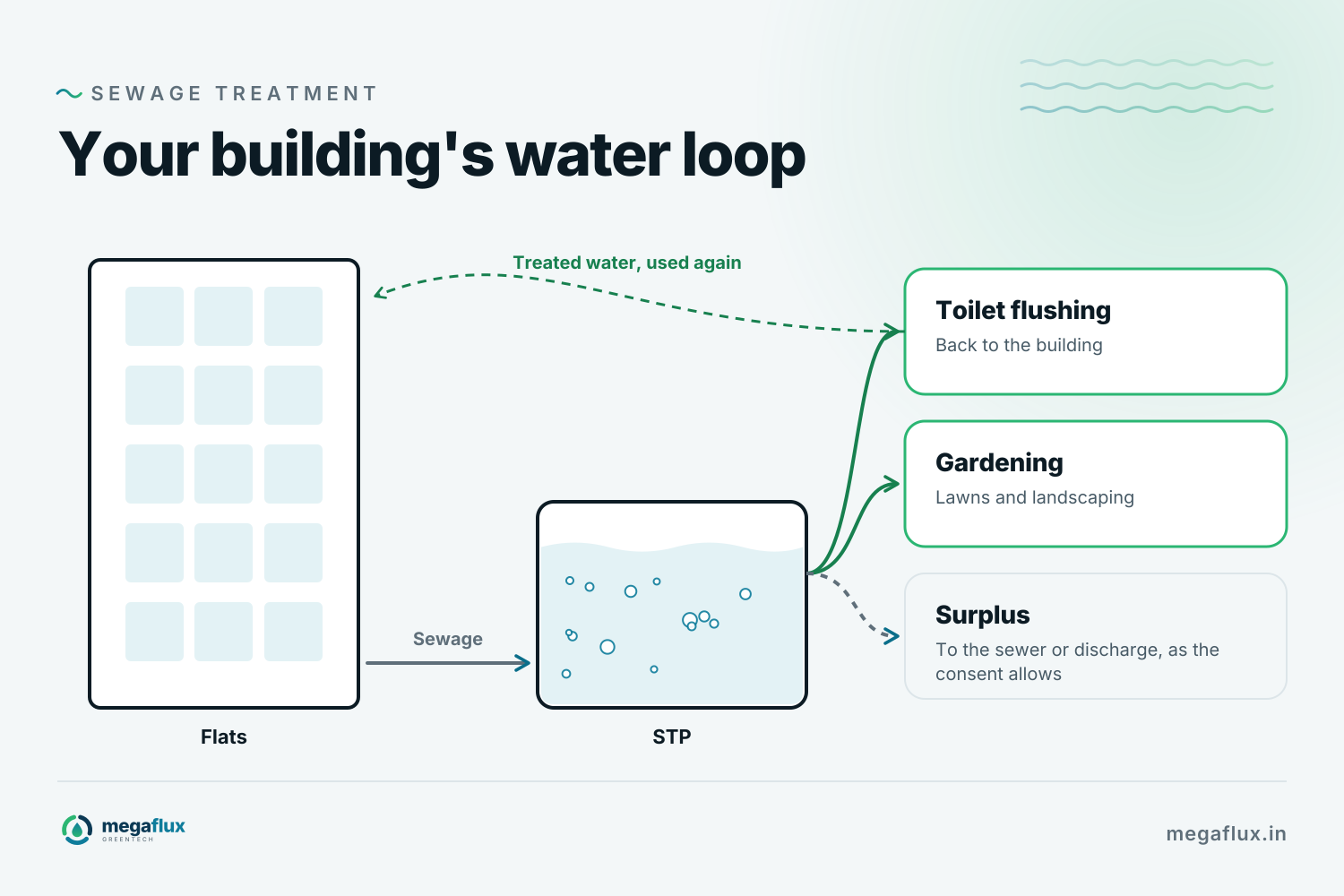
Where does the water go after I flush?
In an older building, the answer was simple. Into the city's sewer line, and someone else's problem.
In many new projects, the answer is different. It goes to a sewage treatment plant (STP) in the basement or the corner of the compound. It gets cleaned there. And often, it comes back to the same building, to flush toilets and water the garden.
That's a very good idea.
But it comes with rules. And it comes with a responsibility that many housing societies only discover after the builder has left.
Why buildings need their own STP now
Three reasons, really:
- Cities are growing faster than their sewer lines. Many new areas don't have a sewer network that can take the extra load, or any network at all.
- Water is scarce. Treated sewage is perfectly good for flushing, gardening and cooling. Using it twice saves fresh water.
- The law expects it. For larger projects, an STP is a condition of the approvals that let the project be built and occupied.
When is an STP required?
There's no single number that covers every building. But here's how it usually works.
Large projects: environmental clearance
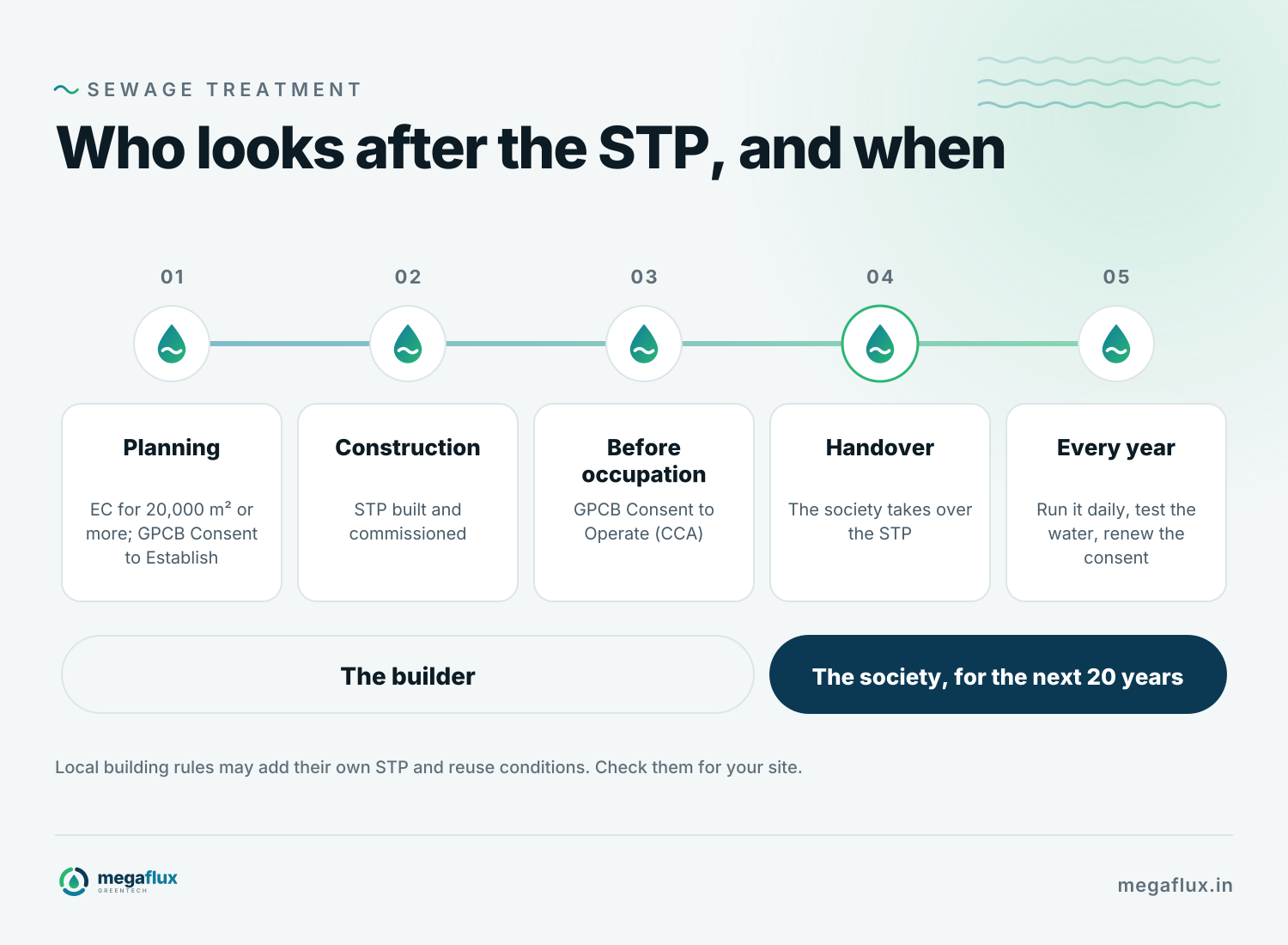
Under India's EIA Notification, 2006, building and construction projects with a built-up area of 20,000 m² or more need an environmental clearance (EC) before construction starts.
The EC usually comes with conditions. Most commonly: treat the sewage on site, reuse the treated water, and keep records.
Pollution control board consent
In Gujarat, an STP that discharges treated water is regulated by the Gujarat Pollution Control Board (GPCB), under the Water Act, 1974. Just like a factory's ETP, it typically needs two consents:
- Consent to Establish (CTE), before the STP is built.
- Consent to Operate (CCA), before it starts running, and renewed on time after that.
(We explain how these consents work in GPCB consent, explained.)
Local building rules
On top of that, the municipal corporation or development authority may ask for an STP, dual plumbing or water reuse as part of the building permission. These rules vary by city and by project size, so your architect or consultant is the right person to confirm them for your site.
The part nobody talks about: the handover
Here's what happens in a lot of projects.
The builder designs the STP, builds it, gets it approved and runs it for the first few months. Then the society is formed. The keys are handed over.
And with the keys comes the STP.
બિલ્ડર ગયો, પ્લાન્ટ રહ્યો.
The builder leaves. The plant stays.
From that day, the society is responsible for:
- Running it every day. Blowers, pumps and dosing have to work around the clock.
- Testing the treated water to show it meets the limits in the consent.
- Renewing the consent before it expires.
- Paying for it: power, an operator, chemicals and maintenance.
An STP that's switched off to save electricity isn't just a smell problem. It can mean a breach of the consent conditions.
Five questions every society should ask at handover
- Is the Consent to Operate valid, and when does it expire? Ask for a copy.
- What's the plant's design capacity, and how many flats is it for? A plant sized for half-occupancy will struggle when the building fills up.
- Which technology is it? MBBR, SBR or something else. Each needs different care. (See MBBR vs SBR.)
- Where are the drawings, manuals and test reports? You'll need them for every renewal.
- Who will operate it, and is there an AMC? A trained operator is the difference between a plant that works and a plant that just exists.
What a well-run STP gives back
It's easy to see an STP as a cost.
But a plant that runs well gives the society something back:
- Water for flushing and gardening, so less fresh water has to be bought or pumped.
- No smell, no complaints.
- Peace of mind at every consent renewal.
Treat it like the lift or the fire system. It isn't optional, and it isn't someone else's job.
The takeaway
An STP is built in a year. It's run for twenty.
The rules get it built. The society keeps it working.
Planning a new project, or just taken over an STP at handover? Tell us the number of flats and the plant you have. We'll help you understand what it needs, or design a sewage treatment plant that's easy to run from day one.
Does your society know when its STP consent expires?