
InsightsReverse osmosisગુજરાતીમાં વાંચો
RO plant AMC: what a good maintenance contract should cover
Two AMCs can carry the same price and give you very different plants a year later. Here's what to look for before you sign one.
Do you service your car only when it breaks down?
Probably not. You change the oil, check the tyres and get it serviced on time. Because you know that a breakdown on the highway costs far more than a service in the garage.
An RO plant is the same. Only it's quieter about its problems.
It doesn't make a noise when the membranes start to foul. It just makes a little less water each week. Then a little more power. Then one day, the output is down by a third and the membranes need replacing years too early.
That's what an AMC (annual maintenance contract) is meant to prevent.
But not every AMC does.
The two kinds of AMC
Most suppliers offer one of two kinds:
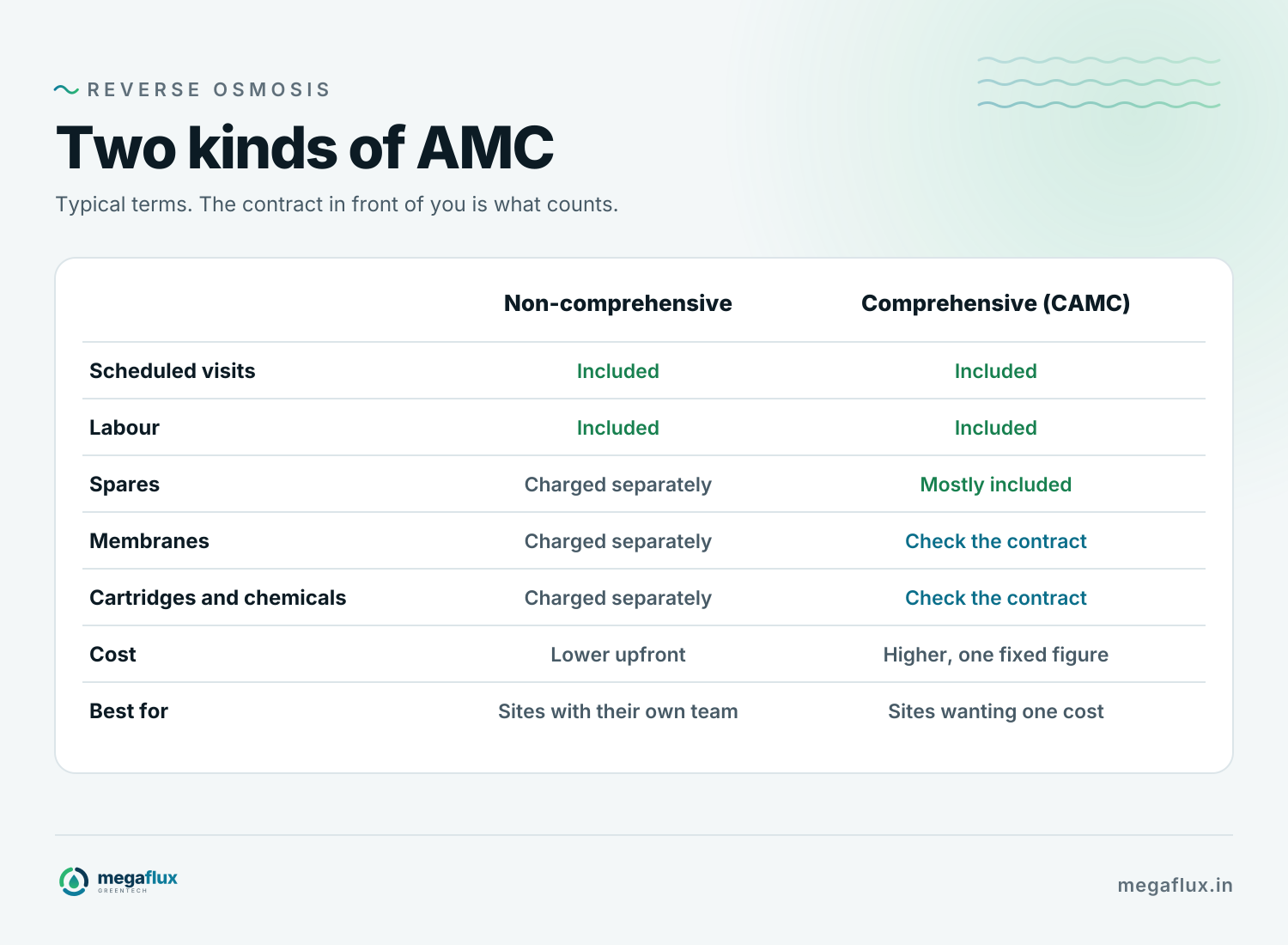
Non-comprehensive AMC = visits and labour. Spares are charged separately.
Comprehensive AMC (often called CAMC) = visits, labour and most spares. Usually costs more upfront.
Neither is right or wrong. A non-comprehensive AMC suits a site with its own maintenance team and a budget for spares. A comprehensive AMC suits a site that wants one predictable cost for the year.
The trap is in the fine print. "Comprehensive" rarely means everything. Membranes, chemicals and filter cartridges are often left out. So the real question is: what exactly is included?
What a good AMC covers
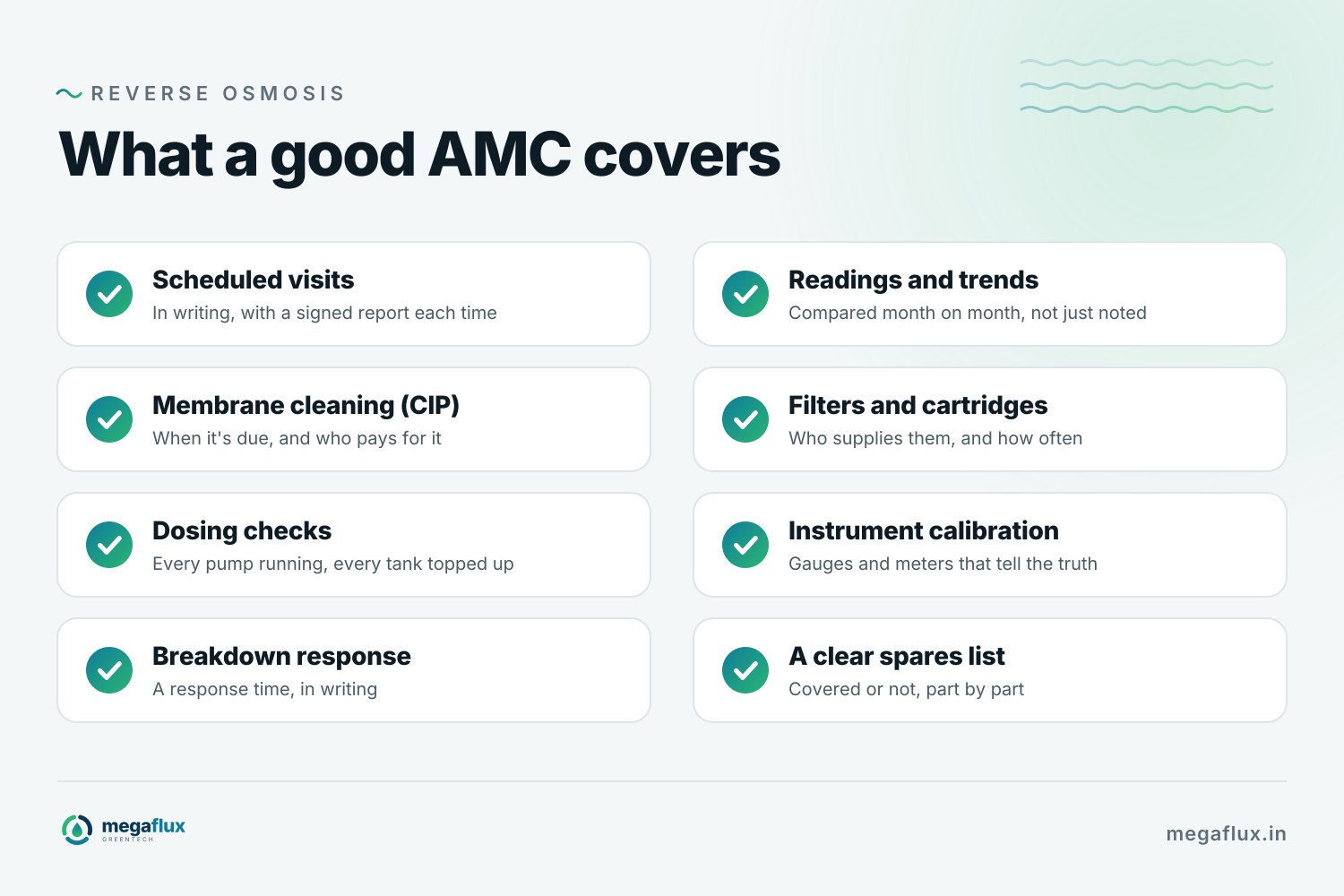
1. Scheduled visits, in writing
How often will an engineer come? Monthly? Quarterly?
It should be written down, with a visit report you sign each time. "As and when required" isn't a schedule.
2. Someone actually reads the numbers
Every RO plant has a few numbers that tell its health story: pressure, flow, and the TDS of the water going in and coming out.
A good AMC engineer doesn't just note them down. They compare them with last month's. That's how fouling is caught early, while a simple cleaning can still fix it.
If nobody is looking at the trend, the AMC is only a repair service.
3. Membrane cleaning (CIP)
Membranes need a chemical clean from time to time. It's called CIP, short for cleaning in place.
Ask:
- Is cleaning included, or charged per clean?
- Who decides when it's needed?
- Are the cleaning chemicals included?
Cleaning too late is one of the main reasons membranes die young. (We wrote about that in why RO membranes fail early.)
4. Filters and cartridges
The cartridge filters ahead of the RO are its first line of defence. They're cheap, and they need changing regularly.
Make sure the AMC says who supplies them, and how often they're changed.
5. Chemical dosing checks
Antiscalant and other dosing chemicals protect the membranes. If a dosing pump stops, or the dose is wrong, damage starts within days.
A good visit checks that every dosing pump is running and every tank is topped up.
6. Instruments that tell the truth
Pressure gauges, flow meters and TDS meters drift over time. If they're wrong, every decision based on them is wrong too.
Ask whether calibration is part of the contract.
7. Breakdown response
When the plant stops, how fast does someone come?
Ask for a response time in writing, and ask whether breakdown visits are included or charged extra.
8. A clear spares list
The AMC should list which parts are covered and which are not. Pumps, valves, gauges, membranes, UV lamps and electrical parts should each have a clear yes or no.
No list = arguments later.
9. Operator training
The person running your plant every day matters more than any contract.
A good AMC includes a little time to train them: what to check each shift, what to log, and what to do when a number looks wrong.
Five red flags
Be careful if the AMC:
- Has no visit schedule, only "on call".
- Gives no visit reports, or reports with no readings.
- Is silent on membranes and cleaning.
- Has no response time for breakdowns.
- Is far cheaper than every other quote. Someone is cutting a corner. It's usually the visits.
The takeaway
A cheap AMC and a good AMC look the same on day one.
The difference shows up a year later, in the membranes, the power bill and the water output.
An AMC isn't a cost. It's insurance for the most expensive parts of your plant.
Running an RO plant today? Send us your current AMC, or just your plant's readings. We'll tell you honestly what's covered, what's missing, and what your plant is telling you. Every RO plant we build comes with service and AMC options.
When did someone last show you the trend of your plant's readings?