
STP for housing societies: MBBR vs SBR
The two most common technologies for a society's sewage treatment plant, how each works, and how to choose between them for your building.
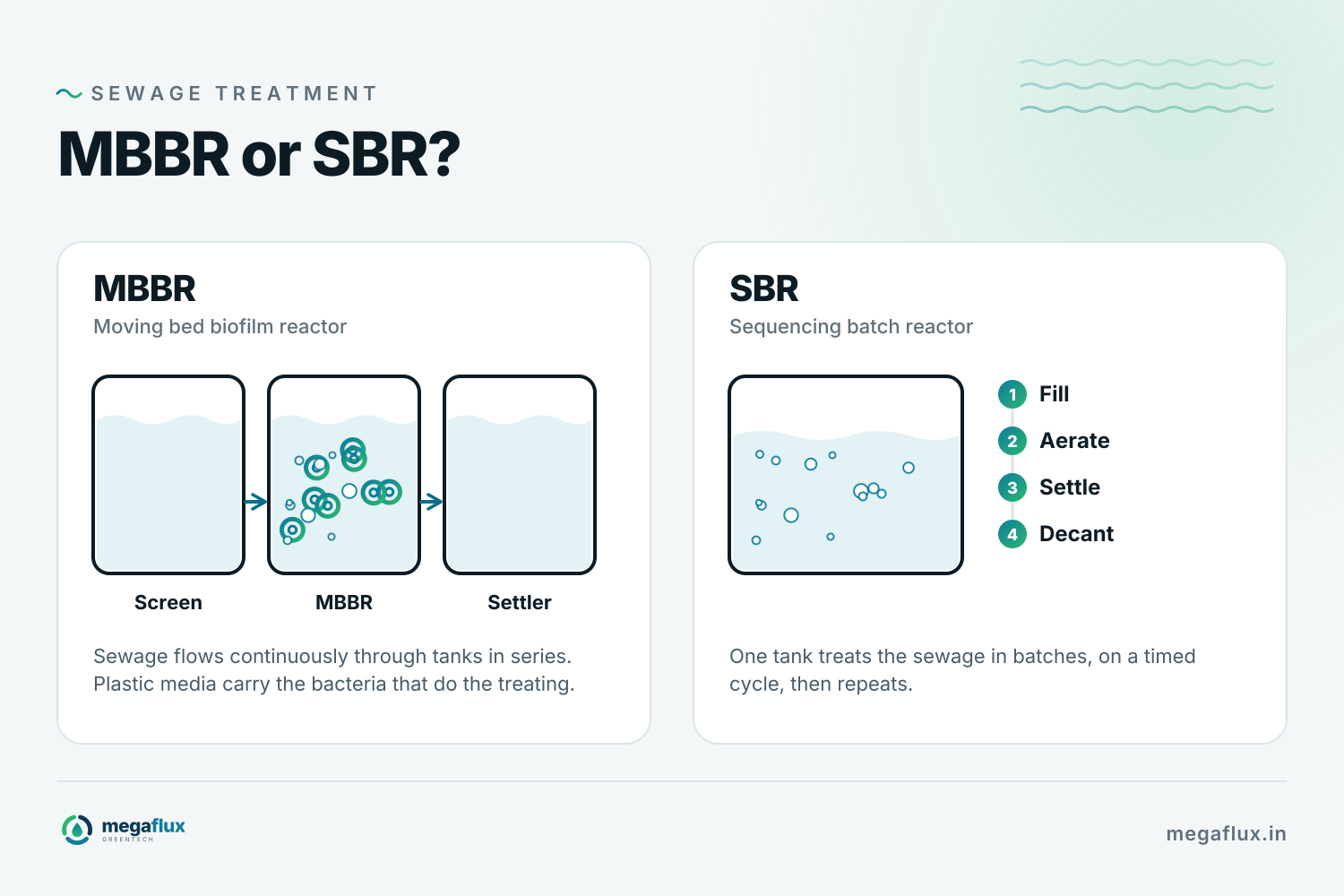
Most large residential projects in India need their own sewage treatment plant, and many housing societies inherit one from the builder. When it is time to choose a new STP, or replace one that never worked well, two technologies come up again and again: MBBR and SBR.
Both are compact, both work well when they are designed and run properly, and both can produce water good enough to reuse. The difference is in how they treat the sewage.
How an MBBR works
MBBR stands for moving bed biofilm reactor. Sewage flows continuously through a series of tanks. In the main aeration tank, thousands of small plastic carriers, the "media", tumble around in the water. Bacteria grow as a film on the media and break down the organic load in the sewage as it passes.
Because the bacteria live on the media rather than floating freely, an MBBR packs a lot of treatment into a small tank, and copes well with day-to-day changes in load. If the society grows, capacity can often be added by putting more media into the tank.
How an SBR works
SBR stands for sequencing batch reactor. Instead of flowing through tanks in series, the sewage is treated in batches in the same tank, on a timed cycle.
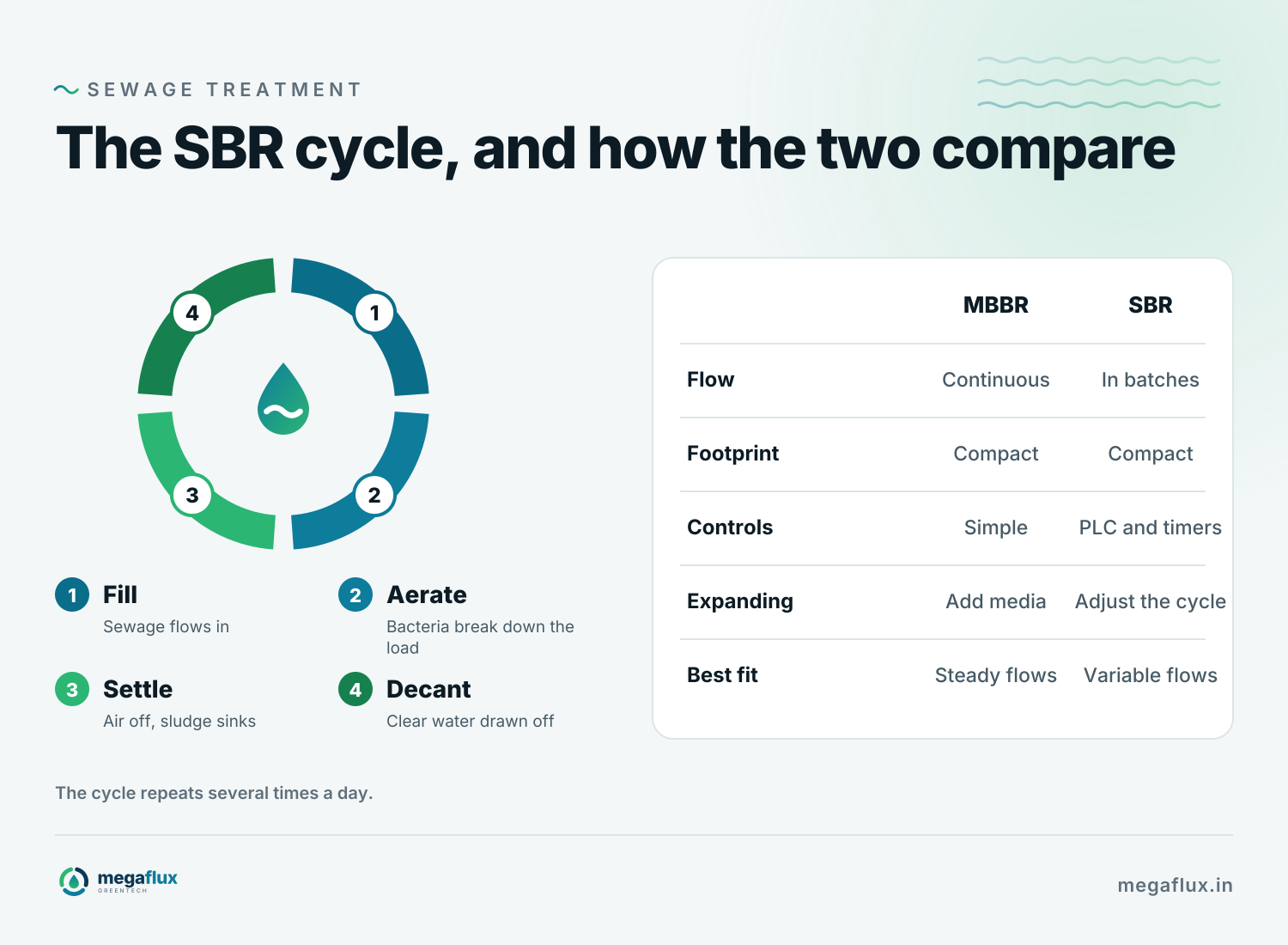
- Fill: sewage flows into the tank.
- Aerate: blowers supply air, and bacteria break down the organic load.
- Settle: the air is turned off and the sludge sinks to the bottom.
- Decant: clear treated water is drawn off the top.
The cycle then repeats, several times a day. An SBR needs good automation, a PLC and timers, to run each stage at the right moment. In return, it handles variable flows well, and the cycle can be adjusted as the load changes.
Which is right for your society?
- Steady flows and simple operation: MBBR is often the easier choice. It runs continuously with fewer moving parts in its controls.
- Very uneven flows: SBR suits sites where the flow swings a lot through the day or the week, such as hotels, schools and offices, because each batch can be treated fully before the next.
- Space: both are compact. The final choice usually depends on the shape of the space available, not just its area.
- Who will run it: an SBR's automation must be maintained properly. If the society has no one to look after the controls, factor that in.
How big an STP do you need?
STPs are sized by the volume of sewage they treat each day, in kilolitres a day (KLD). Indian design norms often take water use at around 135 litres per person per day, with about 80% of that becoming sewage.
For example, a society of 200 flats with an average of 4.5 people each produces roughly 200 × 4.5 × 135 × 0.8 litres, or about 100 KLD. A designer will add margin for peak flows and future growth, so it is worth sizing the plant from real water-use data where you have it.
Reusing the treated water
With filtration and disinfection after the biological stage, treated water can be reused for toilet flushing, gardening and cooling. In a large society, that can cut fresh-water demand, and tanker bills, by a significant share. Reuse needs separate plumbing, so it is far easier to plan at the design stage than to retrofit.
Why society STPs fail, and how to avoid it
Most STP complaints, such as smell, foam and poor-quality water, come from operation, not technology. The usual causes:
- Blowers switched off to save power. Without air, the bacteria die and the plant turns septic and smells.
- Sludge not removed. Sludge builds up until it washes out with the treated water.
- No trained operator. Small problems go unnoticed until they become big ones.
- Oil and grease from kitchens. This coats the media and starves the bacteria.
A clear operating routine and a maintenance contract do more for an STP than the choice between MBBR and SBR.
Tell us how many flats or people your plant serves and how much space you have, and we'll recommend the right sewage treatment plant for your society.