
InsightsWater softeningગુજરાતીમાં વાંચો
Boiler feed water: softener, RO, or both?
A boiler turns water into steam and leaves everything else behind. What you feed it decides how much fuel you burn, how often you drain it, and how long it lasts.
Have you ever boiled milk and forgotten about it?
The water goes. The milk solids stay, and they stick to the bottom of the pan.
A boiler does exactly the same thing, every hour, all day.
Water goes in. Steam goes out. Everything that was dissolved in the water stays behind. And unless you manage it, it ends up as scale on the tubes, sludge at the bottom, or a bigger fuel bill at the end of the month.
So the question isn't whether to treat boiler feed water. It's how much.
Why scale is so expensive
Scale is a layer of rock (mostly calcium and magnesium) that forms on the hot surfaces inside a boiler.
Rock is a poor conductor of heat. So the burner has to work harder to push the same heat through. That means:
- More fuel for the same steam.
- Hotter tube metal, which weakens it over time.
- More shutdowns for cleaning and repairs.
A thin layer you can barely see is already costing you money.
The hidden cost: blowdown
Here's the part most people miss.
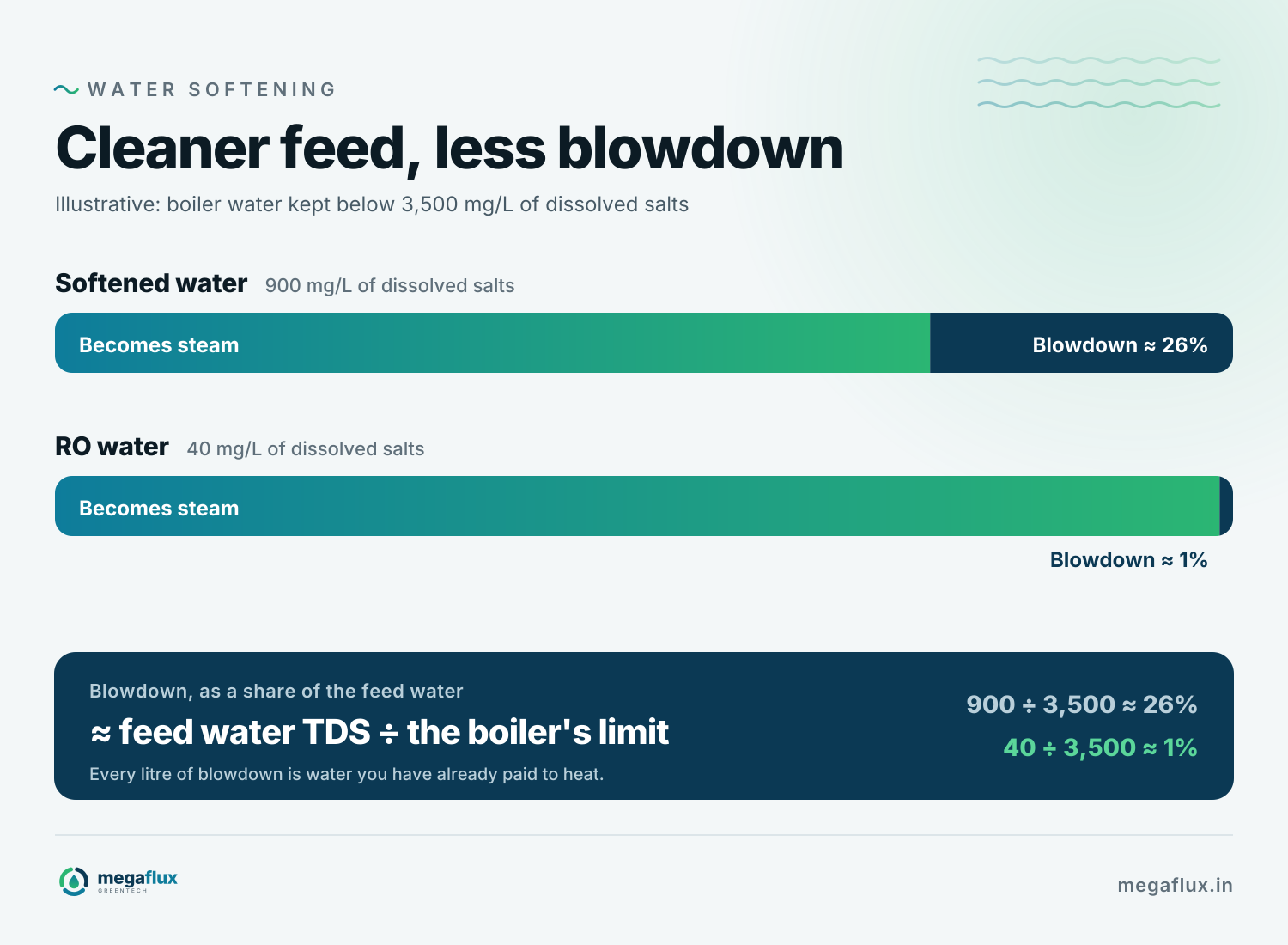
Because the dissolved salts stay behind, their level inside the boiler keeps rising. Past a limit, the water starts to foam and carry over into the steam. So the operator drains some hot boiler water and replaces it with fresh feed water.
That drain is called blowdown.
And every litre of blowdown is a litre of water you already paid to heat.
The rule is simple:
Dirty feed water = more blowdown = more fuel down the drain.
Clean feed water = less blowdown = more steam from the same fuel.
Option 1: the softener
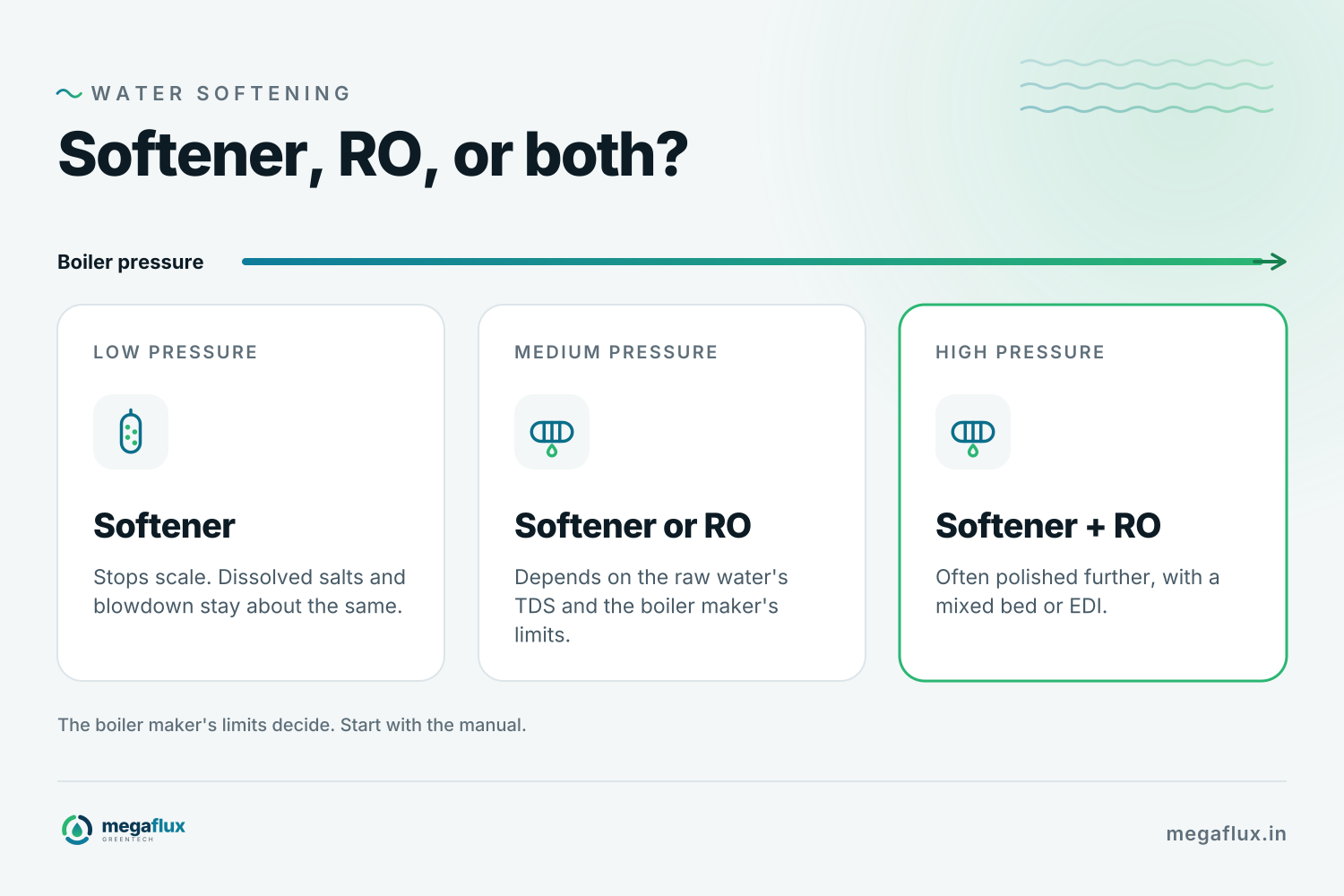
A softener swaps calcium and magnesium for sodium. Hardness goes away, so scale stops.
But the total dissolved salts (TDS) stay about the same. So blowdown stays about the same too.
A softener is often the right answer when:
- The boiler is a low-pressure one, such as many small shell boilers in food units, laundries and textile process houses.
- The raw water's TDS is moderate.
- The budget is tight and the boiler maker is happy with softened water.
It's simple, cheap to run, and does one job very well.
Option 2: the RO plant
Reverse osmosis removes most of the dissolved salts, not just the hardness.
So you get no scale and very little blowdown.
RO starts to make sense when:
- The boiler runs at higher pressure, where the maker's limits on feed water are much stricter.
- The raw water's TDS is high, so a softener alone would still mean heavy blowdown.
- You run the boiler long hours, so the fuel saved on blowdown adds up quickly.
The trade-off: RO costs more to buy and run. It uses power, needs membrane care, and sends part of its water to drain as reject. (We broke those costs down in what an RO plant costs to run.)
Option 3: both
This one surprises people.
Very often the best answer is a softener and an RO plant, one after the other.
- The softener takes out the hardness, which protects the RO membranes from scale.
- The RO takes out the dissolved salts, which protects the boiler and cuts blowdown.
For high-pressure boilers, the RO water is sometimes polished further still, with a mixed-bed unit or EDI, to reach the purity the boiler demands.
So, which one do you need?
It comes down to three things:
- Your boiler's pressure, and what its maker says. The manual sets the feed water and boiler water limits. (The Indian Standard for low and medium pressure boilers is IS 10392.) Start there.
- Your raw water. Hardness and TDS from a water test report tell you how far the water is from those limits.
- How hard the boiler works. A boiler running three shifts a day pays back better treatment much faster than one that runs a few hours a week.
In short:
Softener = stops scale.
RO = stops scale and cuts blowdown.
Both = protects the boiler and the RO.
The takeaway
The boiler is the one machine in the plant that punishes poor water every single hour.
Cheap feed water treatment can be the most expensive decision in the boiler house. You just pay for it slowly, in fuel.
Tell us your boiler's pressure and send us your water report. We'll tell you whether a softener, an RO plant or both is the right fit.
How often does your boiler need descaling today?