
InsightsCompliance and regulations
Do you need an ETP? GPCB consent in Gujarat, explained
If your unit discharges industrial wastewater, your consent from the Gujarat Pollution Control Board will set limits it must meet. What the consents are, and where an effluent treatment plant fits.
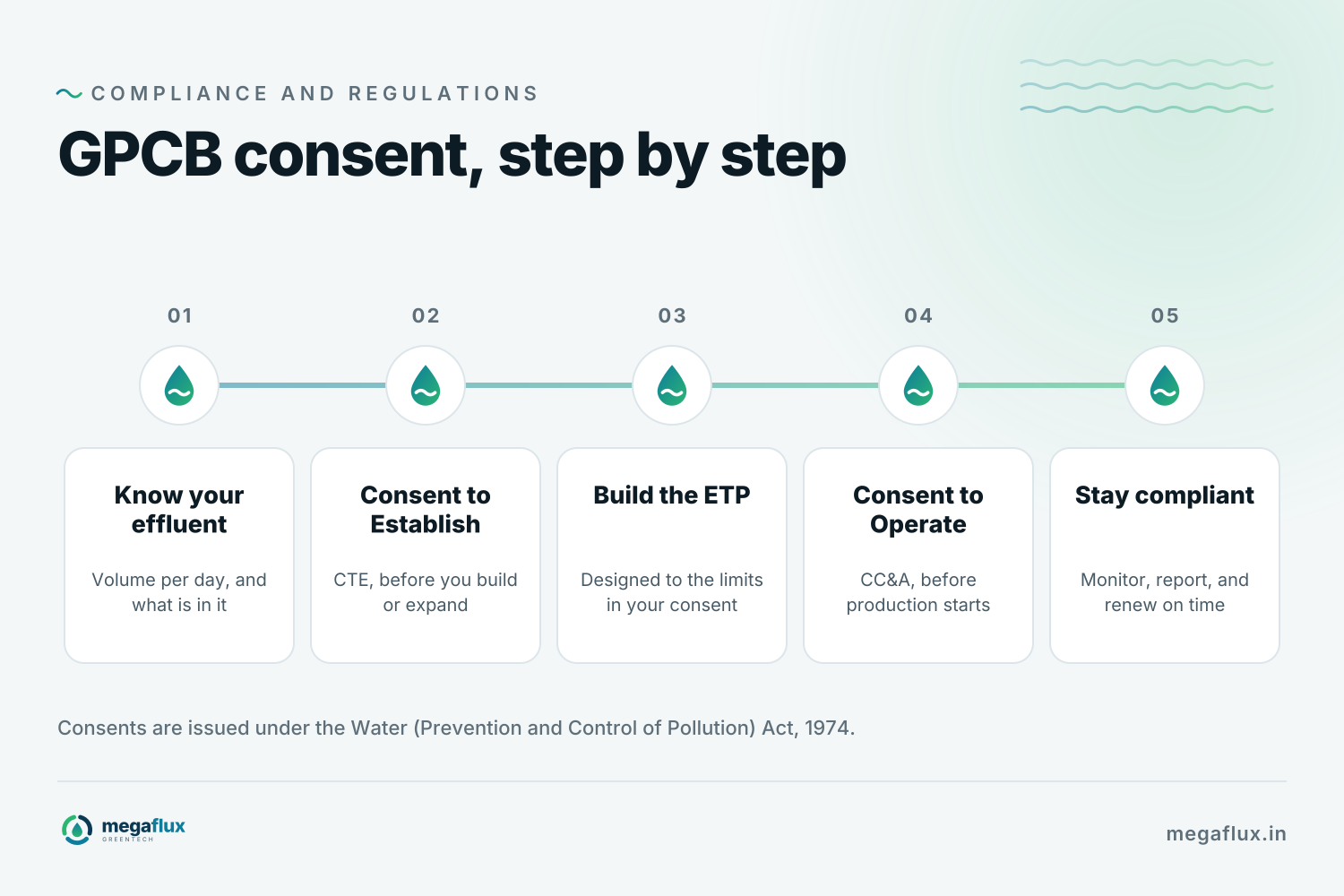
If your factory produces wastewater from its process, sooner or later the question comes up: do we need an effluent treatment plant? In Gujarat, the answer is usually decided by your consent from the Gujarat Pollution Control Board (GPCB). This guide explains how the consents work and where an ETP fits in.
It is a practical guide, not legal advice. Your consent conditions, and GPCB's current requirements, are what apply to your unit.
Why consent matters
Under the Water (Prevention and Control of Pollution) Act, 1974, an industry that discharges trade effluent needs consent from the state pollution control board. In Gujarat, that is GPCB. The consent sets the conditions you must meet, including the quality of any effluent you discharge.
An ETP is how most units meet those conditions. It treats the wastewater so that what leaves your site is within the limits in your consent, or clean enough to reuse.
The two consents
Consent to Establish (CTE). You need this before you set up a new unit or expand an existing one. The application describes your process, the effluent you expect to generate, and how you will treat it. This is the stage to plan your ETP, not after the factory is built.
Consolidated Consent and Authorisation (CC&A). In Gujarat, this is the consent to operate. It is granted before production starts, and it covers your water and air consents, and authorisation for hazardous waste, in one document. It has a validity period and has to be renewed.
How strict the process is depends on your industry's category. Industries are classified as red, orange, green or white by how polluting they are. Red-category industries face the closest scrutiny; white-category industries are exempt from consent.
What your effluent must meet
Your consent sets the limits for your site. They depend on where your treated effluent goes: into a river or drain, onto land, into a sewer, or to a common effluent treatment plant (CETP), which has its own inlet norms.
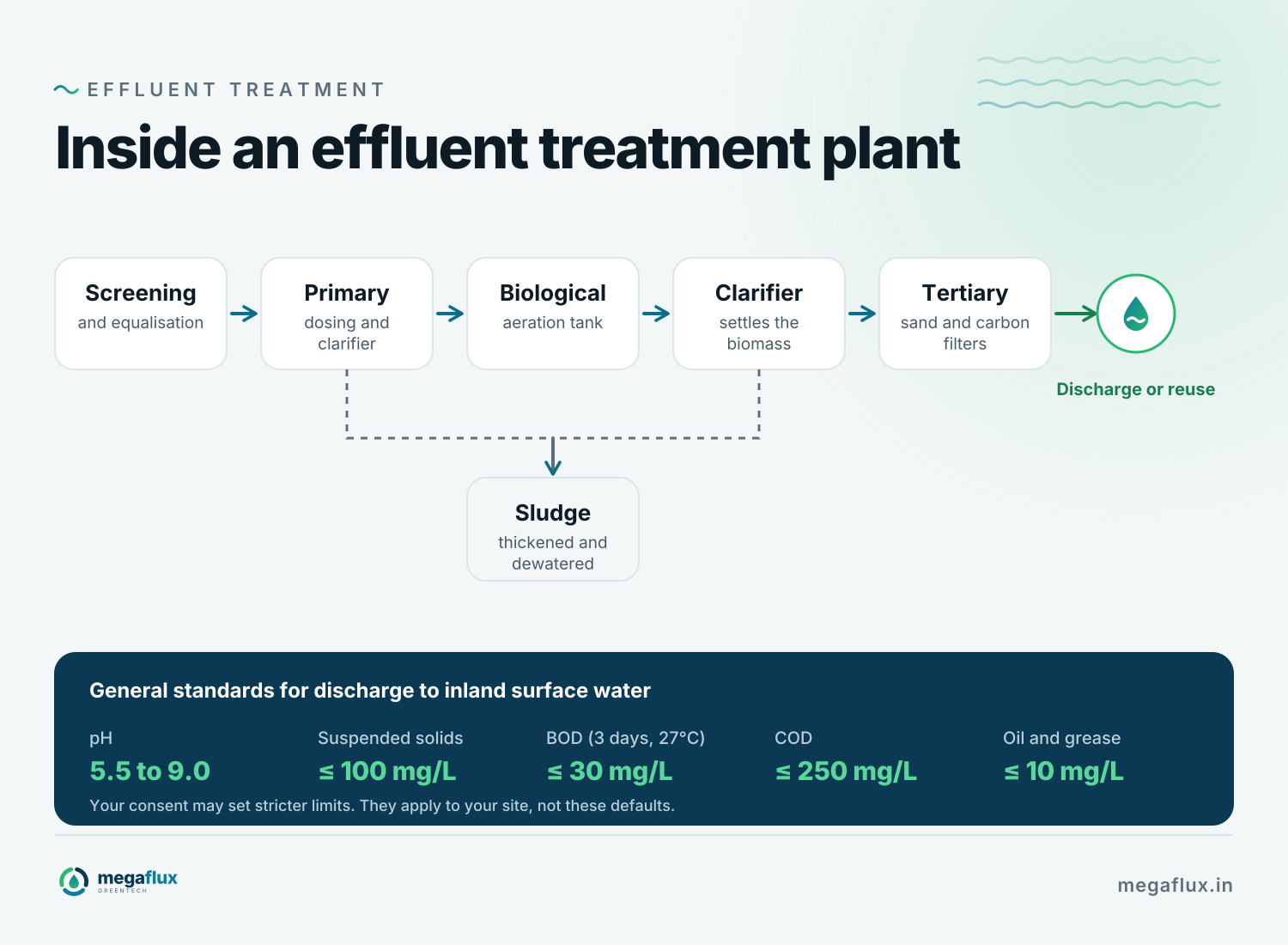
As a reference point, the general standards for discharge into inland surface water include:
- pH: 5.5 to 9.0
- Suspended solids: 100 mg/L or less
- BOD (3 days at 27°C): 30 mg/L or less
- COD: 250 mg/L or less
- Oil and grease: 10 mg/L or less
Your consent may be stricter, and may add parameters specific to your industry. Some consents require zero liquid discharge, where no effluent leaves the site at all and the treated water is reused.
How an ETP is designed
An ETP is designed around your effluent, so the first step is to characterise it: sample it over several days, measure its volume and how that varies, and test for BOD, COD, suspended solids, TDS, pH, oil and grease, and anything specific to your process.
From there, a typical ETP combines:
- Screening and equalisation to remove solids and even out the flow and strength of the effluent through the day.
- Primary treatment: chemical dosing and a clarifier to remove suspended solids, colour and some pollutants.
- Biological treatment, where microorganisms break down the organic load (BOD and COD), in systems such as activated sludge or MBBR.
- A secondary clarifier to separate the biomass from the treated water.
- Tertiary treatment, such as sand and carbon filters, to polish the water for discharge or reuse.
The sludge from the clarifiers is thickened and dewatered. ETP sludge from many industries is classed as hazardous waste, and has to be stored, handled and sent for disposal under your authorisation.
Staying compliant
Getting your CC&A is the start, not the end. To stay compliant:
- Run the ETP every day the factory runs, with trained operators and a log.
- Test the treated effluent at the frequency your consent requires, and keep the records.
- Keep the plant maintained, so its performance doesn't drift.
- Submit the returns and reports your consent asks for.
- Apply for renewal well before your CC&A expires.
Larger units in highly polluting categories may also need online continuous monitoring, with results sent to the pollution control board.
Where to start
If you are planning a new unit or an expansion, bring your ETP into the plan at the Consent to Establish stage. If you already run one that struggles to meet its limits, start with a fresh characterisation of your effluent: processes change, and an ETP designed for yesterday's effluent may not suit today's.
Send us your effluent analysis, daily volume and the limits in your consent, and we'll design an effluent treatment plant to meet them.