
InsightsReverse osmosisગુજરાતીમાં વાંચો
How to read a water test report before you buy an RO plant
That one sheet of numbers from the lab decides the size, the price and the running cost of your plant. Here's what each number means, in plain words.
Would you buy spectacles without an eye test?
Of course not. The optician has to know your number first.
An RO plant is no different. Before anyone can tell you what plant you need, what it costs, or what it will cost to run, they need one thing: your water test report.
Most people get the report, see a page of chemistry, and file it away. That's a pity. Because once you know how to read it, you can tell in five minutes whether the plant you've been quoted actually fits your water.
Let's read one together.
First, a quick word on units
Most lines on the report end in mg/L (milligrams per litre). Some labs write ppm (parts per million). For water, the two are the same thing.
So "TDS 900 mg/L" simply means: in every litre of your water, 900 milligrams of stuff is dissolved. You can't see it. But your boiler, your pipes and your membranes certainly feel it.
The six numbers that matter most
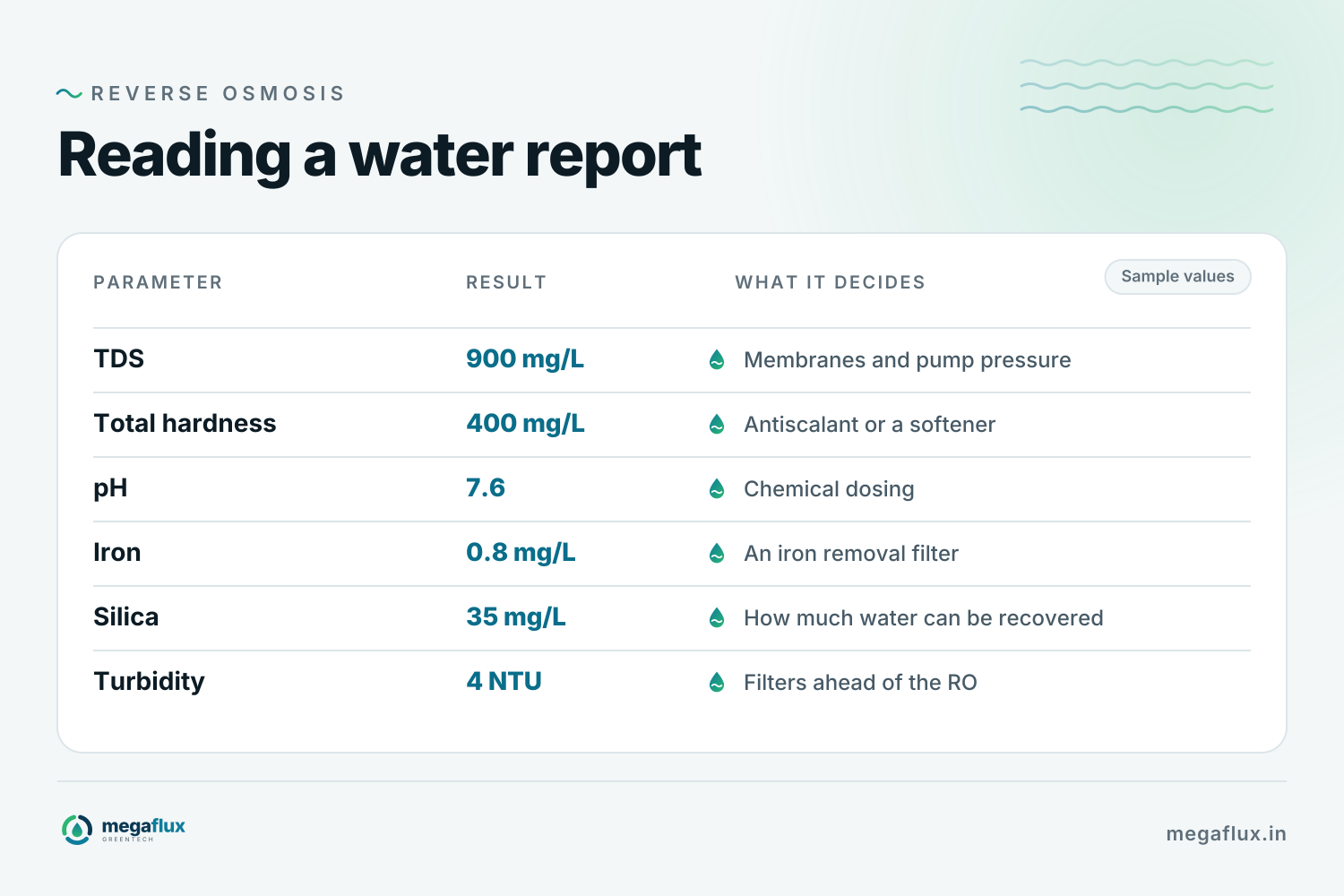
1. TDS: the headline number
Total dissolved solids is the total of all the salts and minerals dissolved in the water.
Think of it as the "saltiness score".
- Low TDS = an easy job for the plant.
- High TDS = more pressure, more power, more care.
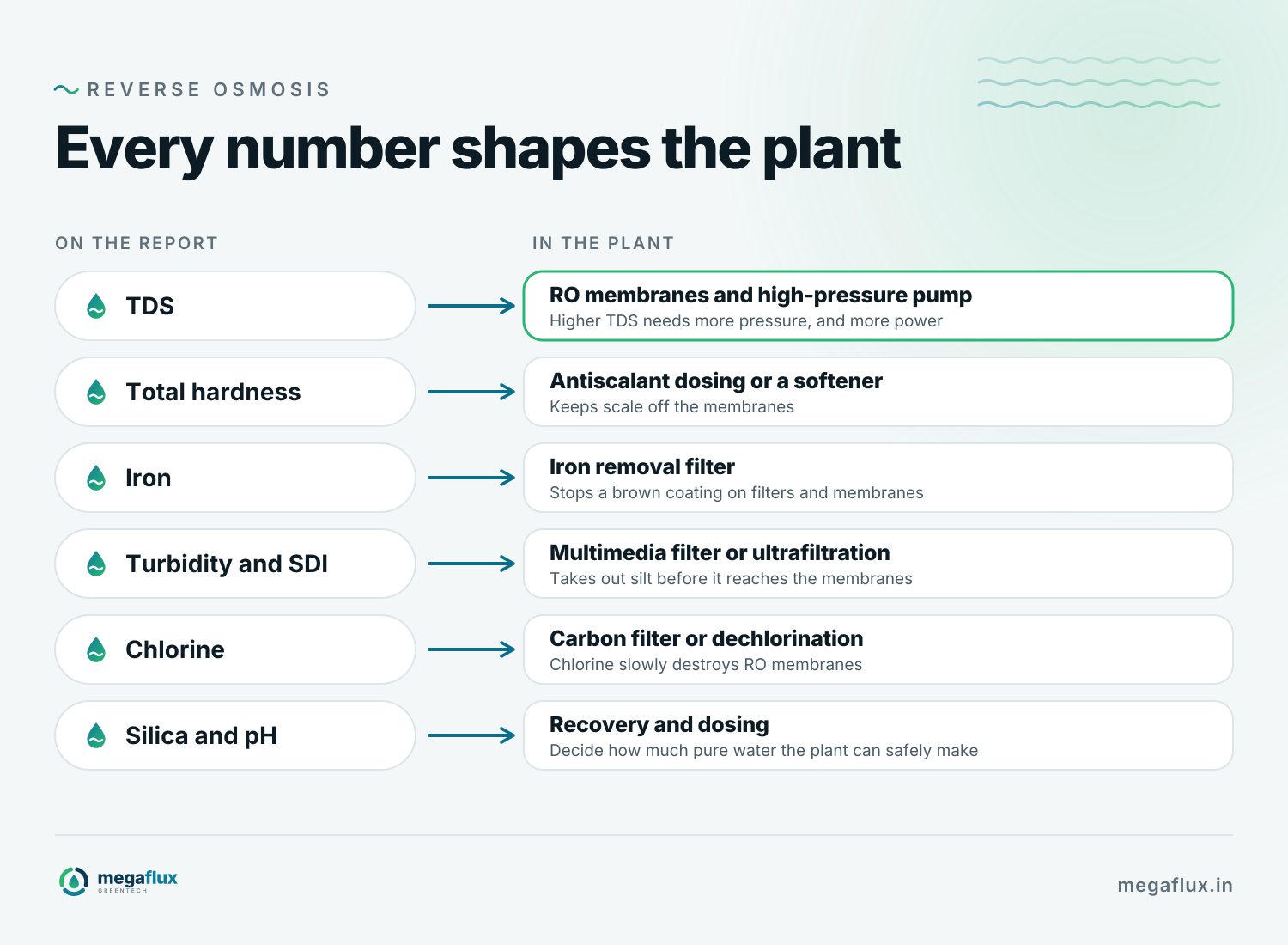
TDS is the number that decides which membranes go in, how hard the pump has to push, and how much of your water comes out pure. For drinking water, the Indian standard (IS 10500) treats 500 mg/L as acceptable and 2,000 mg/L as the upper limit when nothing better is available.
2. Total hardness: the scale maker
Hardness is the calcium and magnesium in the water. It's the white crust you see on a kettle, a tap or a bathroom tile.
Inside a plant, that same crust forms on the membranes. Slowly. Quietly. Until one day the water output drops and nobody knows why.
High hardness doesn't mean you can't use RO. It means the plant needs protection ahead of the membranes: antiscalant dosing, or a softener. (We explain the difference in RO plant or water softener.)
3. pH: the mood of the water
pH tells you whether the water is acidic, neutral or alkaline. 7 is neutral.
Most borewell water sits somewhere between 6.5 and 8.5, and that's fine. But pH changes how other minerals behave. It's the number the designer uses to fine-tune the chemical dosing, so scale doesn't form.
4. Iron: small number, big trouble
Iron often shows up as a tiny figure, like 0.5 or 1.0 mg/L. Easy to ignore.
Don't.
Iron stains, it clogs filters, and it coats membranes in a brown layer that's hard to clean. If your report shows iron, a good plant will have an iron removal filter before the RO. If the quote you're holding doesn't mention iron at all, ask why.
5. Silica: the quiet one
Silica is dissolved sand, in a sense. It doesn't make the water taste or look different.
But it forms a glassy scale on membranes that is very hard to remove. Silica is often the real reason a plant can't squeeze out as much pure water as you'd like. It sets the safe limit on how much water the plant can recover.
6. Turbidity: is the water cloudy?
Turbidity measures how cloudy the water is, from fine silt, clay or organic matter.
Membranes hate dirt. Cloudy water needs good pre-filtration (sand, multimedia or ultrafiltration) before it reaches them. Many labs also report an SDI (silt density index), a sharper test of how quickly fine particles will clog a membrane.
Two more lines worth a glance
- Chlorine: Great for killing germs. Terrible for RO membranes, which it slowly eats away. If your water is chlorinated (municipal supply, or a tank you dose), the plant needs a carbon filter or a dechlorination step.
- Chlorides and sulphates: Parts of the TDS. They matter for corrosion, and for deciding what the reject water can be used for.
What a report can't tell you
A report is a snapshot of one day.
Borewell water often changes with the season. TDS can climb in summer, when the water table falls. A tanker supply can change from one load to the next.
So the best practice is simple:
Test more than once. And tell the designer where the water comes from.
Three questions to ask before you sign
Once you can read your report, ask whoever is quoting you:
- "Which numbers on my report did you design for?" A good supplier will point to them.
- "What pre-treatment have you included, and why?" Iron filter, softener, antiscalant, carbon filter. Each one should trace back to a line on your report.
- "What happens if my TDS goes up in summer?" A well-designed plant has headroom. A tight one struggles.
If the answers are vague, the design probably is too.
The takeaway
જેવું પાણી, તેવો પ્લાન્ટ.
As the water, so the plant.
A water report isn't paperwork. It's the blueprint. The right plant is built on it, and a wrong plant is usually built without it.
Got a report sitting in a drawer? Send it to us with a line on what the water is for. We'll walk you through what it says, and what kind of RO plant it calls for.
What's the one number on your water report you've never understood?