
How much does an industrial RO plant cost to run?
The purchase price is the smaller number. Power, chemicals, membranes and labour decide what an RO plant really costs, and how to compare quotes on them.
Most RO quotes are compared on one number: the price of the plant. But over its life, an industrial RO plant usually costs several times its purchase price to run. Two plants with the same capacity can have very different running costs, and the difference adds up to lakhs of rupees.
Here is what goes into that running cost, a worked example, and the questions to ask before you choose a plant.
The five costs of running an RO plant
1. Power. This is almost always the biggest cost. The high-pressure pump does most of the work, pushing water through the membranes; feed and dosing pumps add a little more. For a brackish or borewell RO plant, the total is typically in the range of 0.5 to 1.5 kWh for every m³ of treated water. Where your plant falls in that range depends on the salt in your feed water, the recovery it runs at, the membranes chosen and how efficient the pump is.
2. Operator time. Someone has to log readings, check dosing, change cartridges and respond to alarms. A well-automated plant needs less of their time, but never none.
3. Chemicals. Antiscalant stops hardness and silica from scaling the membranes. Many plants also dose a dechlorinating chemical, adjust pH, and use cleaning chemicals a few times a year.
4. Membranes. With good pre-treatment and timely cleaning, RO membranes typically last three to five years. Poor pre-treatment can halve that. Spread over their life, membranes are a steady cost per m³.
5. Cartridges and consumables. The micron cartridge filters ahead of the membranes are replaced every few weeks or months, depending on how dirty the feed water is.
A worked example
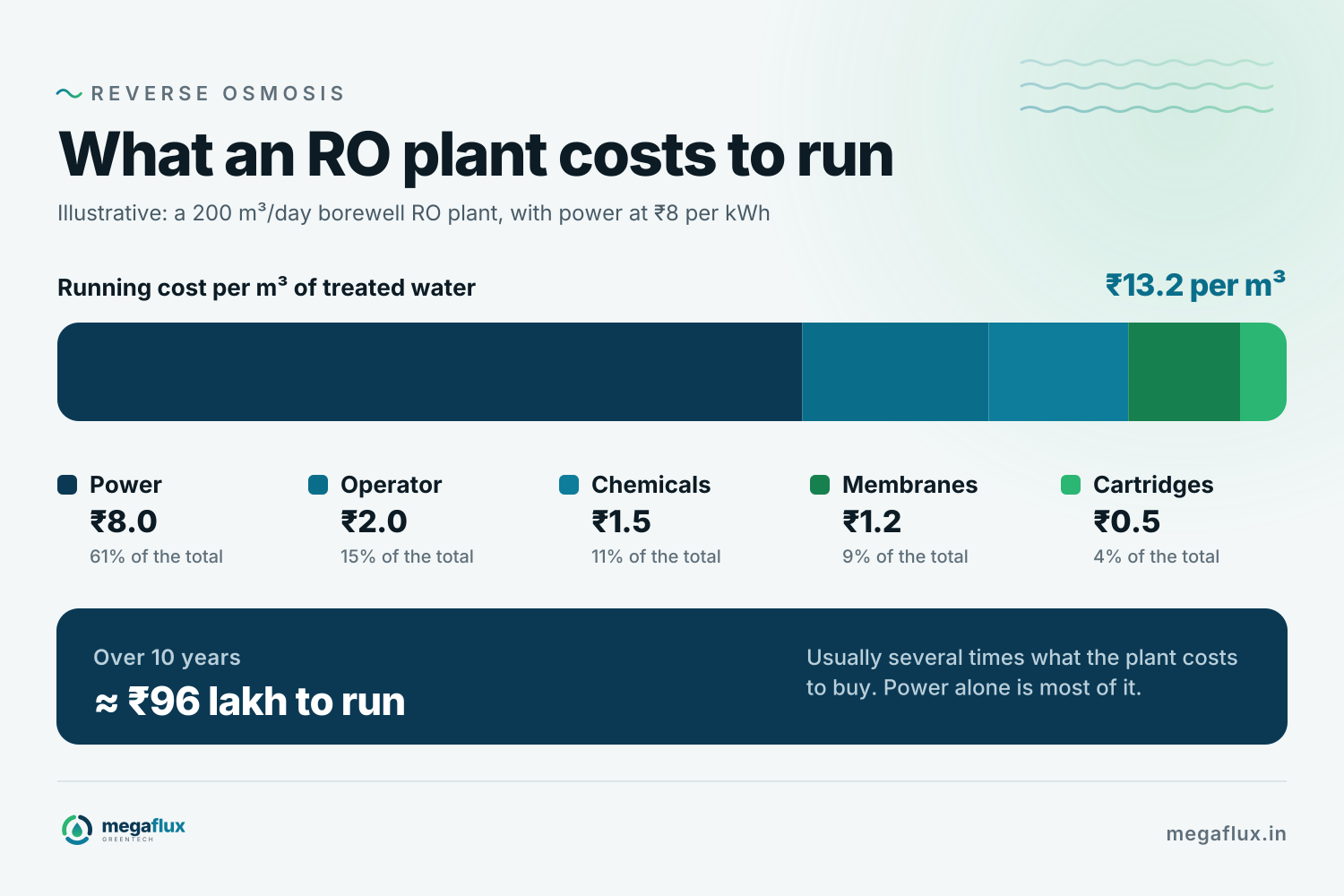
Take an illustrative borewell RO plant producing 200 m³ of treated water a day, with power at ₹8 per kWh. At about 1 kWh per m³, power alone costs around ₹8 for every m³. Add operator time, chemicals, membranes and cartridges, and the plant costs roughly ₹13 per m³ to run.
That doesn't sound like much until you multiply it out. At 200 m³ a day, it is about ₹9.6 lakh a year, and ₹96 lakh over ten years. That is usually several times what the plant cost to buy.
Why the cheapest plant is often the most expensive
Now compare two plants for the same site. Plant A costs ₹22 lakh and uses 1.4 kWh per m³. Plant B costs ₹28 lakh, because it has better membranes and a more efficient pump, and uses 1.0 kWh per m³.
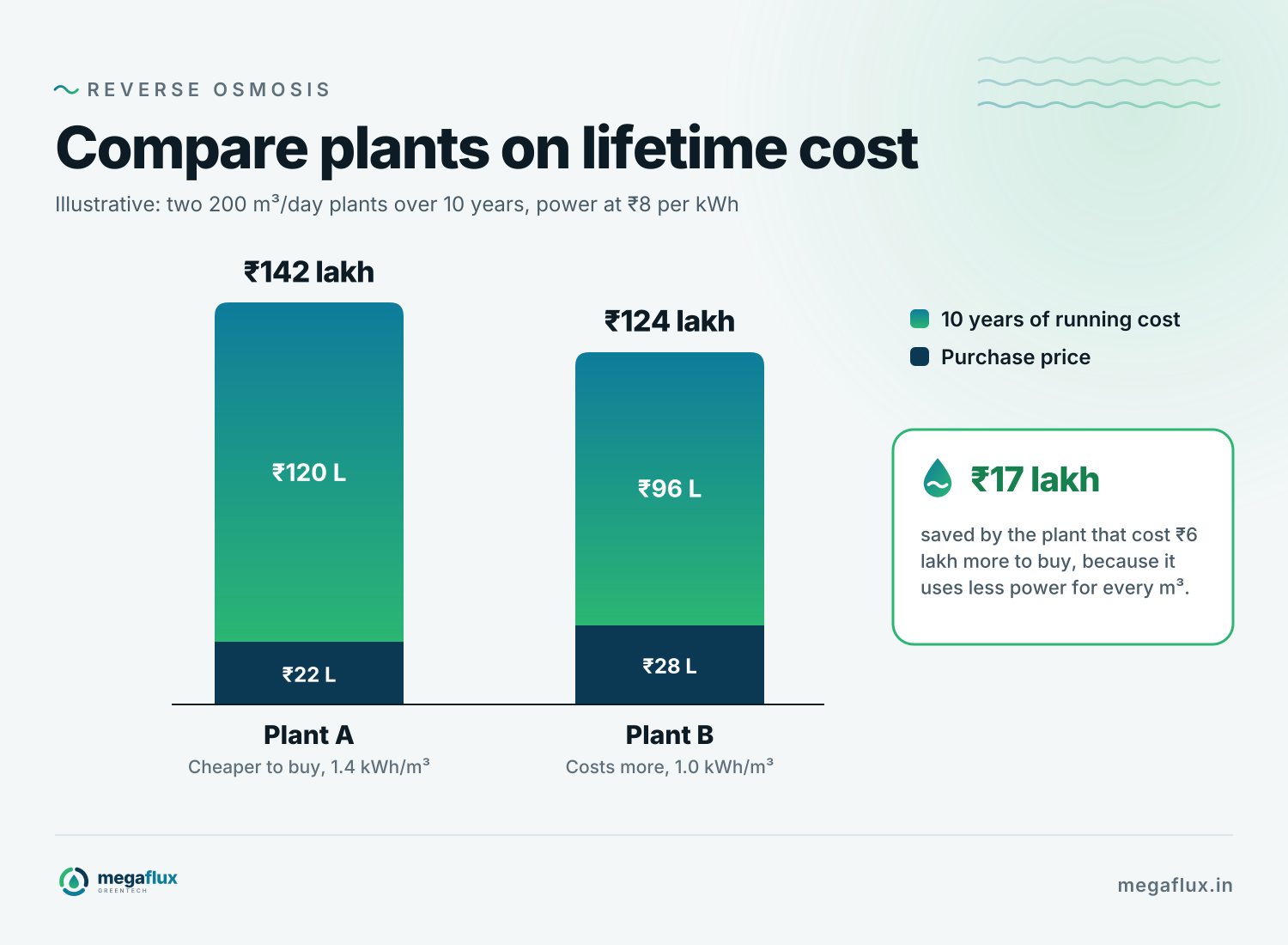
The 0.4 kWh difference is ₹3.20 on every m³. Over ten years and 7.3 lakh m³, that is more than ₹23 lakh. Plant B costs ₹6 lakh more to buy and saves about ₹17 lakh overall.
Recovery: the hidden cost
Recovery is the share of the feed water that becomes treated water. The rest leaves as concentrated reject. A plant running at 75% recovery needs 267 m³ of feed water to make 200 m³ of treated water, and sends 67 m³ to drain.
If your water comes from a tanker, a municipal connection or an expensive borewell, every m³ of reject costs money. Pushing recovery too high isn't the answer either: it raises the risk of scaling and shortens membrane life. The right recovery is a design decision based on your water analysis.
What to ask for in every RO quote
Before you compare prices, ask every supplier to state, in writing:
- Power: kWh per m³ of treated water, at your feed water and design temperature
- Recovery: the recovery the plant is designed for, and how much reject it produces each day
- Chemicals: antiscalant and other chemical doses, and their cost per m³
- Membranes: make and model, design flux, and expected life on your water
- Cartridges: expected replacement interval
- Operation: how much operator time the plant needs each day
- Proof: how these figures will be measured at commissioning
A supplier who can't answer these is asking you to compare plants on the one number that matters least.
How Megaflux quotes
Every Megaflux proposal states what the plant will cost to run, not just what it costs to buy: power per m³, chemical cost, membrane life, recovery and operator time, calculated from your water analysis. At commissioning, we run the plant and measure it against the same figures.
Send us your water report and daily demand, and we'll show you what an industrial RO plant will cost to build and to run.