
Why RO membranes fail early, and how to make them last
RO membranes should last years. When they don't, the cause is almost always scaling, fouling or chlorine, and the warning signs show up in the plant's readings long before the membranes die.
With good pre-treatment and care, the membranes in an industrial RO plant typically last three to five years, often more. Yet many plants replace them every year or two. Each early replacement is an expensive, avoidable cost, and the damage usually starts long before anyone notices.
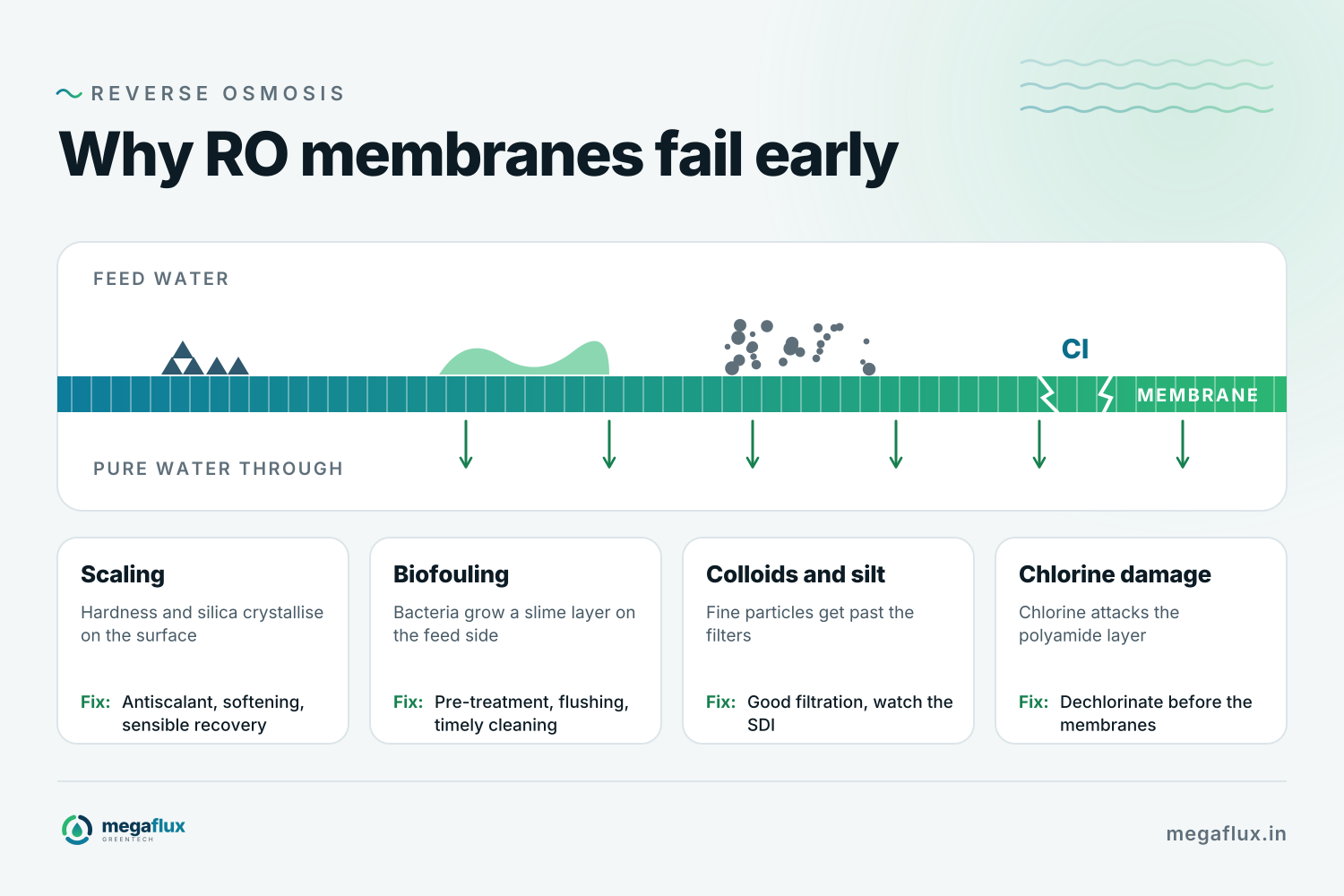
Almost every early failure comes down to four causes.
1. Scaling
When water passes through the membrane, the salts left behind become more and more concentrated. Past a point, the least soluble ones, such as calcium carbonate, calcium sulphate and silica, crystallise on the membrane surface as scale. Scale blocks the membrane, so output falls and the pressure needed rises.
How to prevent it: dose antiscalant, soften the feed water where hardness is high, and don't run the plant at a higher recovery than your water allows. The safe recovery is a design decision based on your water analysis.
2. Biofouling
Bacteria in the feed water settle on the membrane and grow a slimy biofilm. It cuts output, raises the pressure drop across the membranes, and is hard to remove once established. Warm water and plants that stand idle without flushing make it worse.
How to prevent it: keep pre-treatment working, flush the membranes when the plant stops, and clean before the biofilm takes hold.
3. Colloids and silt
Fine particles, colloidal silica, iron and organic matter can slip past poor pre-treatment and coat the membrane surface. The silt density index (SDI) of the feed water measures this risk; membrane makers commonly ask for an SDI below 5, and preferably below 3.
How to prevent it: good filtration ahead of the membranes, cartridge filters changed on time, and regular SDI checks.
4. Chlorine damage
Most RO membranes have a thin polyamide layer that chlorine attacks. Unlike fouling, this damage is permanent: salt starts passing through, and no cleaning will bring it back. It often happens after a dechlorination step fails, or when municipal water's chlorine level rises unexpectedly.
How to prevent it: remove chlorine before the membranes, with sodium metabisulphite dosing or activated carbon, and monitor that it is working.
Watch the readings, not just the output
The warning signs of all four show up in the plant's readings weeks or months before the membranes fail. The catch is that raw readings move with temperature and pressure, so a drop in output in winter can look like fouling when it isn't.
That's why operators track normalised data, corrected to standard conditions: normalised permeate flow, salt passage and the pressure drop across the membranes.
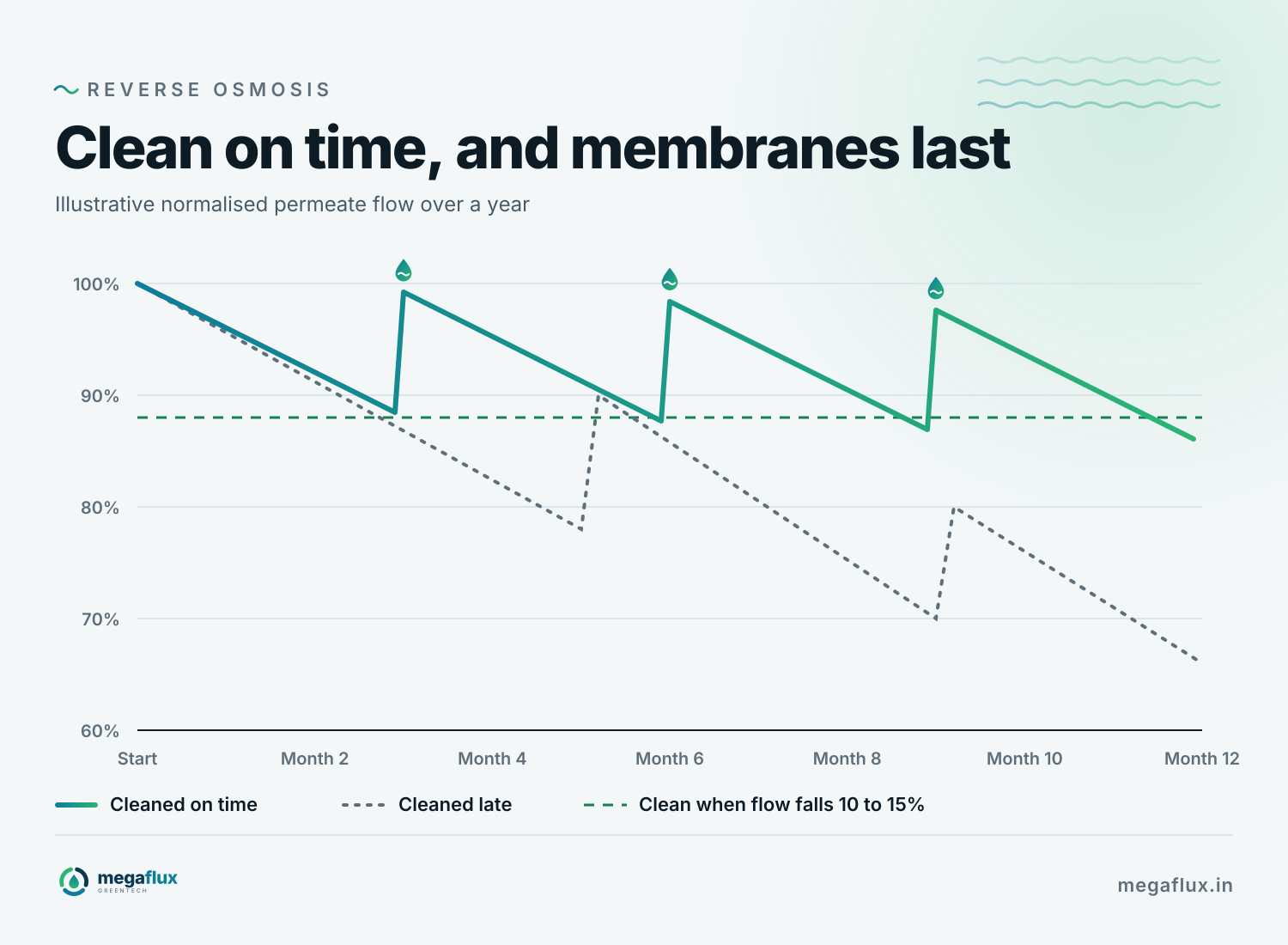
As a general rule, many membrane makers recommend cleaning when:
- normalised permeate flow has fallen by 10 to 15%, or
- salt passage has risen by 5 to 10%, or
- the pressure drop across the membranes has risen by 15%
from their baseline after commissioning or the last cleaning. Your membrane maker's guidance for your membranes comes first.
Clean on time, the right way
Membrane cleaning, done in place, uses different chemicals for different problems: low-pH cleaners for scale and metal oxides, and high-pH cleaners for biofilm and organic fouling. The order matters, and so does timing. Cleaned early, membranes recover almost fully. Left until output has collapsed, they may never recover, and the plant ends up buying new membranes instead.
A checklist for longer membrane life
- Log readings every shift, and normalise them.
- Keep antiscalant and dechlorination dosing working, and check them daily.
- Change cartridge filters on time, and check SDI regularly.
- Flush the membranes whenever the plant stops.
- Clean when the readings say so, not when output has already collapsed.
- Get the plant's design recovery right from the start.
Our service and AMC contracts cover exactly this: scheduled checks, normalised data, timely cleaning and membrane replacement when it is genuinely needed. Send us your plant's recent readings, and we'll tell you how its membranes are doing.