
RO plant or water softener: which does your site need?
Both are sold as answers to hard water, but they solve different problems. How to tell which one your boiler, process or building actually needs.
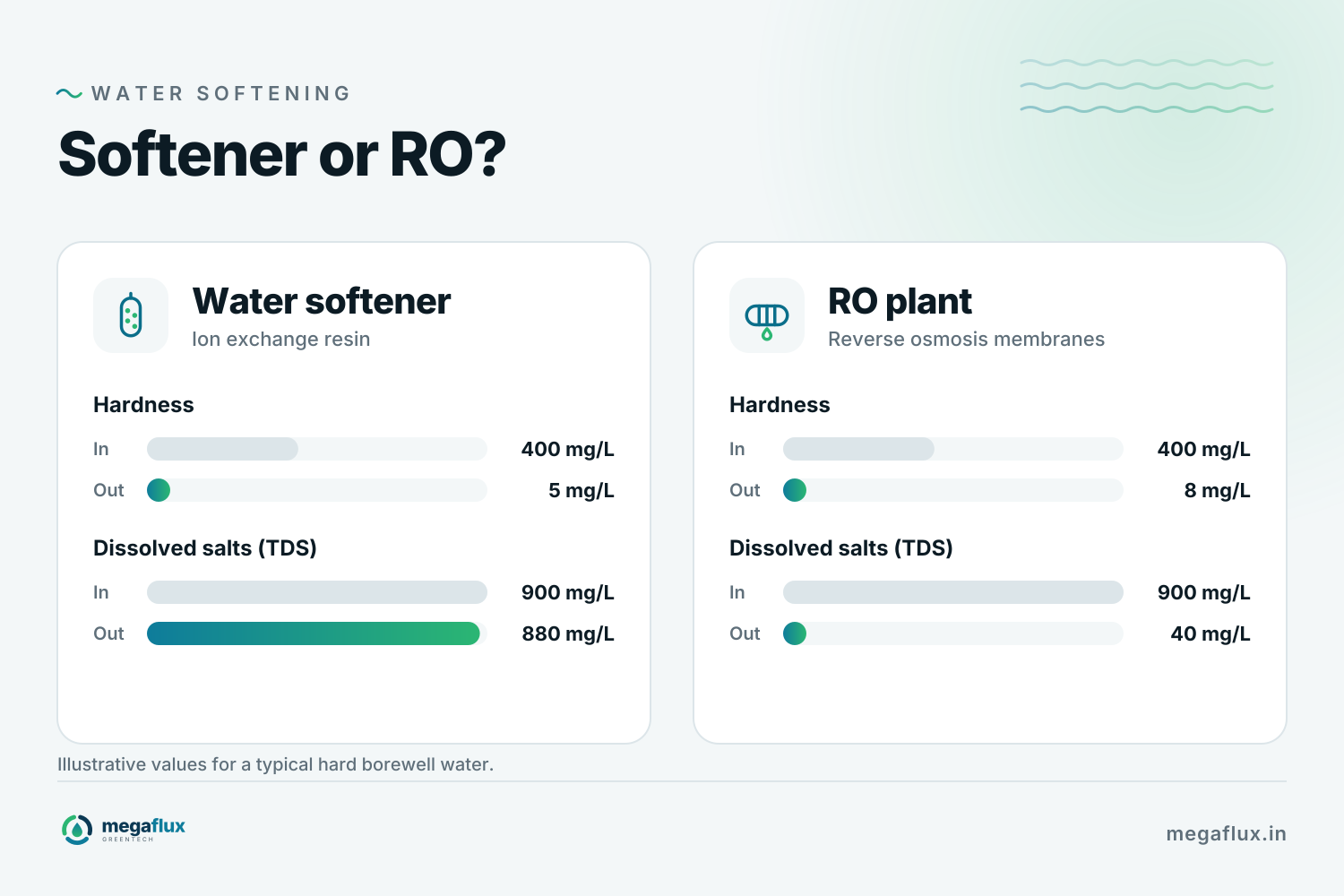
A softener and an RO plant are often mentioned in the same breath, and both are sold as answers to "hard water". But they do different jobs, and buying the wrong one is an expensive mistake: either a plant far bigger than you need, or one that leaves you with the problem you were trying to solve.
What a softener does
A softener removes hardness: the calcium and magnesium that form scale in boilers, heat exchangers, cooling towers and pipes. It does this by ion exchange. Water flows through a bed of resin that swaps the calcium and magnesium for sodium, and the softened water no longer leaves scale behind.
When the resin is full, it is regenerated with brine (salt water) and goes back into service. A well-sized softener can run for years on little more than salt and an occasional resin top-up.
What a softener doesn't do is reduce the total amount of salt in the water. The total dissolved solids (TDS) stay about the same, because one dissolved mineral has simply been swapped for another.
What an RO plant does
Reverse osmosis forces water through a membrane that holds back most dissolved salts, not just hardness. The water that comes out has a much lower TDS, and most bacteria and other impurities are removed too.
That makes RO the right choice when you need genuinely pure water: for drinking, for many process uses in pharma and food, or for high-pressure boilers that need low-TDS feed water.
The trade-off is cost. An RO plant uses more power, needs membrane and cartridge replacements, and sends part of its feed water to drain as concentrated reject. So it is worth paying for only when you need what it does.
Which one do you need?
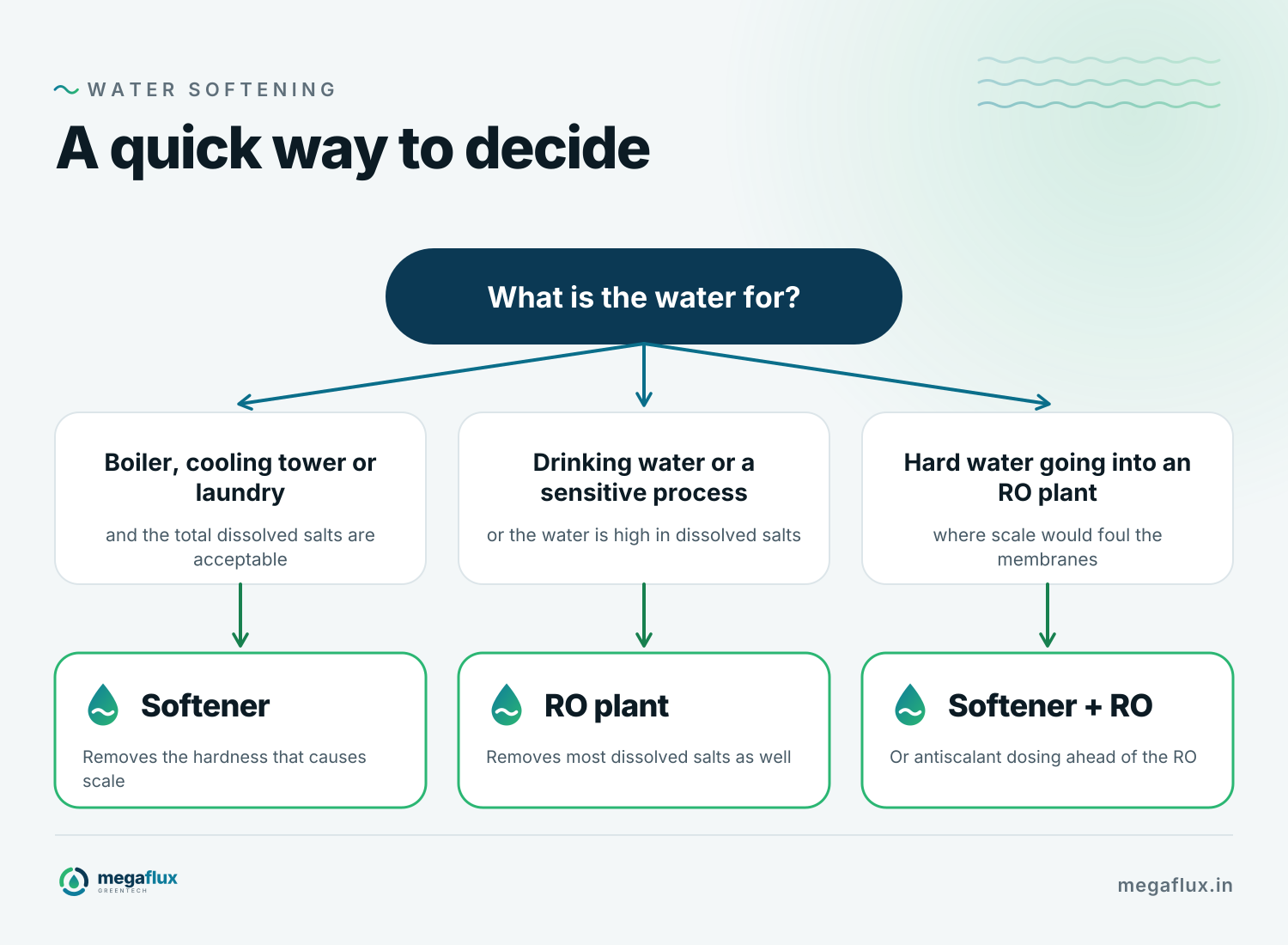
- Scale in a low-pressure boiler, cooling tower or laundry, and the TDS is acceptable: a softener is usually enough, and much cheaper to run.
- Drinking water, a sensitive process, or water that is high in dissolved salts: you need RO. A softener won't bring the TDS down.
- Hard water going into an RO plant: often both. Hardness scales RO membranes, so a softener or antiscalant dosing ahead of the RO protects them and makes them last longer.
A common mistake
Some sites install RO "to be safe" when all they needed was soft water for a boiler or a cooling tower. They pay for the power, the membranes and the water lost as reject for years, for a purity they never use.
The opposite mistake is just as common: a softener installed for a process that really needs low-TDS water. The scale stops, but the product or process still suffers, because the dissolved salts are all still there.
Start with a water analysis
The answer depends on what's in your water and what you're using it for. A water analysis tells you the hardness, the TDS, and anything else that matters, such as iron or silica. It's the first thing we ask for when we size a plant.
Send us your water report and tell us what the water is for, and we'll tell you whether a softener, an RO plant or both is the right answer.