
InsightsWater softeningગુજરાતીમાં વાંચો
Water softener sizing: hardness, resin and how often it regenerates
A softener is sized by one sum: how much hardness your water brings in each day, and how much the resin can hold before it needs regenerating. Here's how to do it, with a worked example.
"We need a 5 m³/hour softener."
We hear this a lot. And it's only half the answer.
Flow tells you how big the pipes and the vessel's diameter should be. It doesn't tell you how much resin you need. That depends on something else entirely: how much hardness your water carries in every day.
Get that wrong and one of two things happens. The softener runs out halfway through the day and lets hard water through. Or it regenerates far more often than it needs to, and burns salt and water doing it.
Here's how sizing actually works.
Step 1: know your hardness, in the right unit
Your water test report will show total hardness. Softener sizing uses it as CaCO₃, in mg/L (the same as ppm).
Two things to check:
- Some reports list calcium and magnesium separately. To get total hardness as CaCO₃: calcium (mg/L) × 2.5, plus magnesium (mg/L) × 4.1.
- Some equipment is rated in grains per gallon. One grain per gallon is about 17.1 mg/L as CaCO₃.
And use your worst water, not your best. Borewell hardness often rises in summer. A softener sized on a winter sample will fall short in May.
Step 2: work out the daily hardness load
This is the number that matters.
Hardness load = hardness × water used per day.
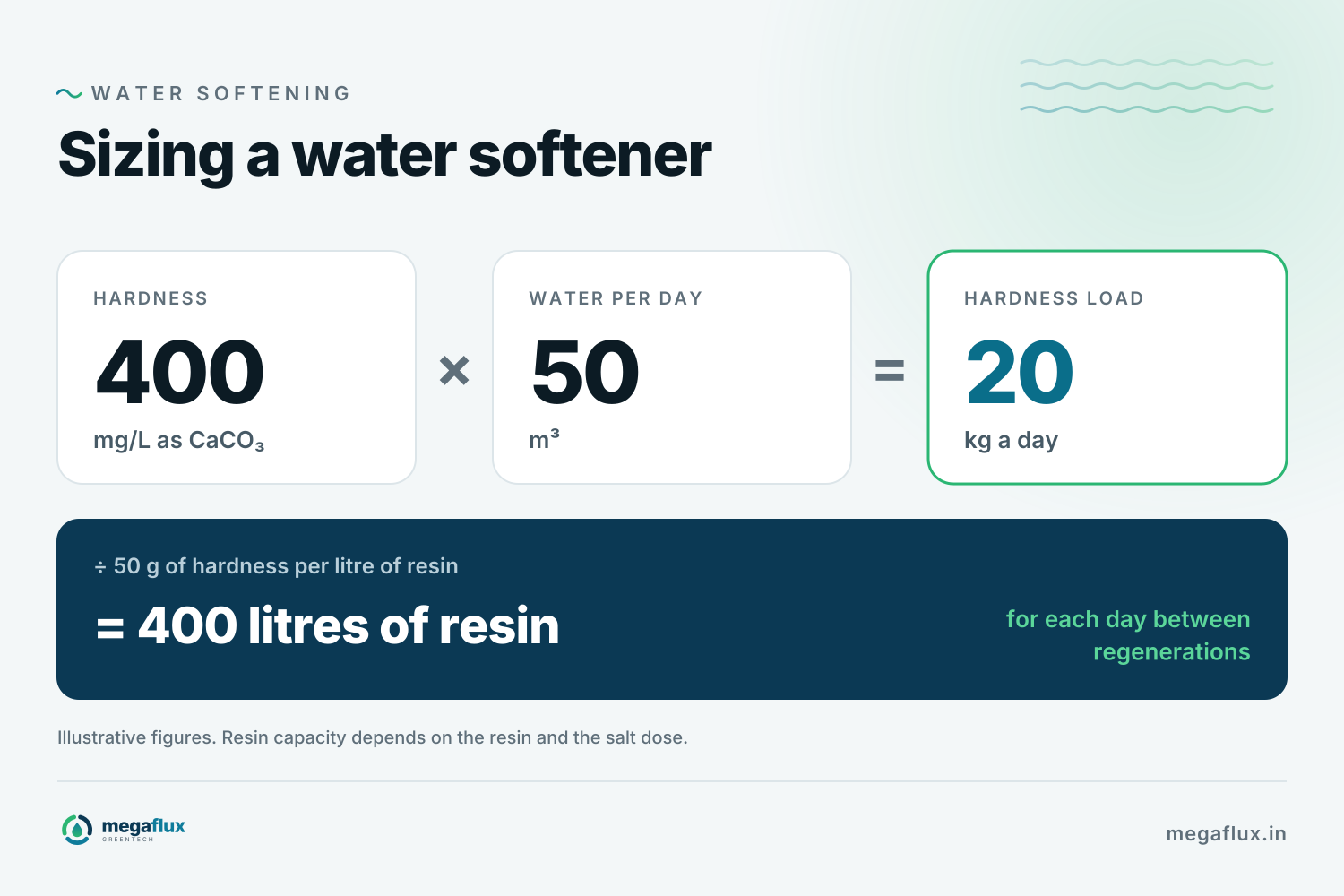
Say your water has 400 mg/L of hardness, and you use 50 m³ a day. Each cubic metre carries 400 g of hardness. So:
400 g × 50 m³ = 20 kg of hardness, every day.
That's what the softener has to catch. It doesn't matter whether the water comes through in eight hours or twenty-four. The resin still has to hold 20 kg.
Step 3: turn it into litres of resin
Softener resin can only hold so much hardness before it's full. That's its operating capacity, usually given in grams of hardness (as CaCO₃) per litre of resin.
The figure isn't fixed. It depends on the resin, and on how much salt you use to regenerate it. For our example, take an illustrative 50 g per litre.
So, to run one full day between regenerations:
20,000 g ÷ 50 g per litre = 400 litres of resin.
Want it to run two days? Double it. Then add a margin, so the softener isn't running right up to the edge every cycle.
Step 4: decide how often it regenerates
Here's the part that surprises people.
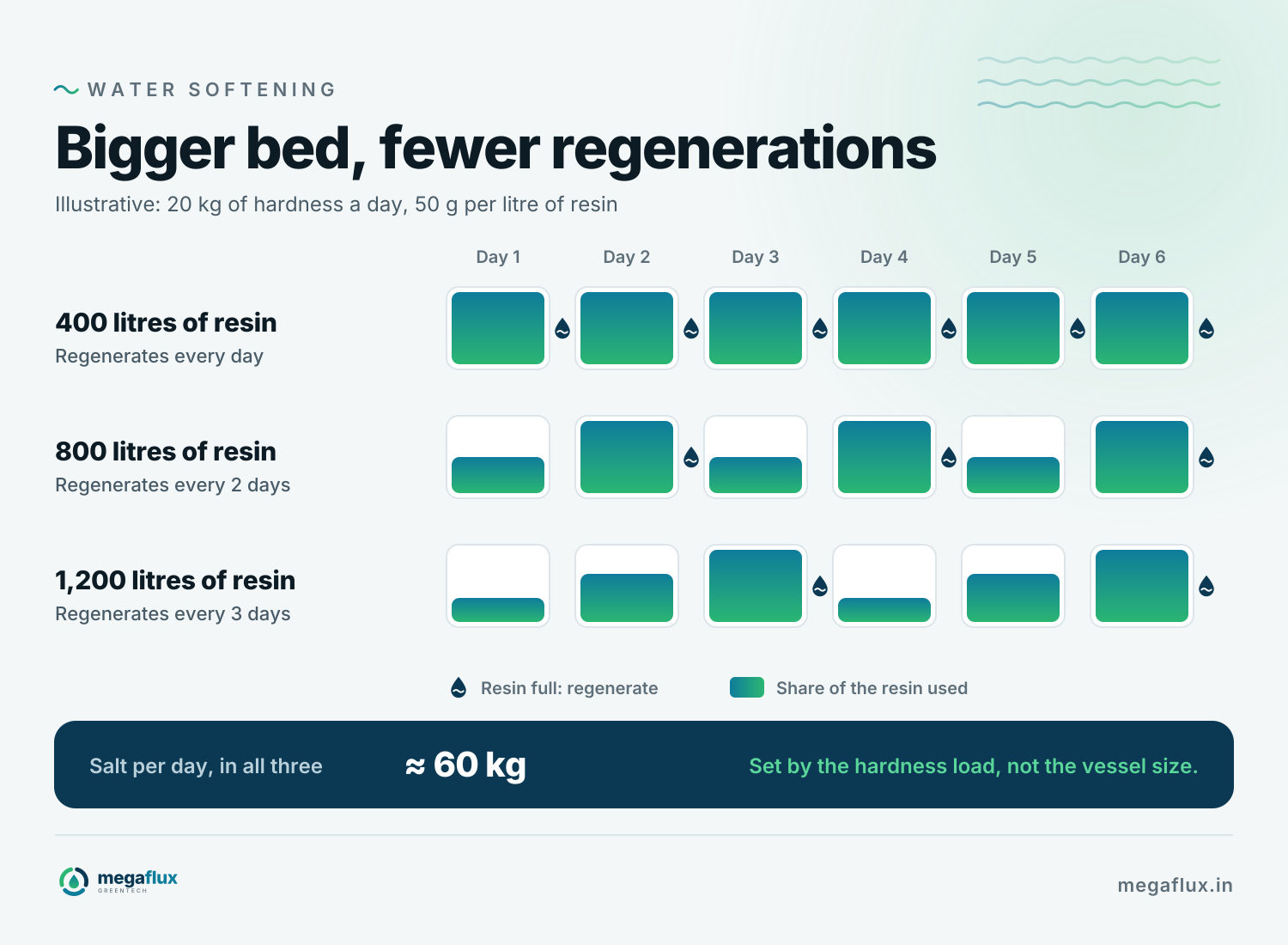
A bigger resin bed regenerates less often. But it uses about the same salt per day.
Why? Because the salt is used to wash out the hardness the resin caught. And the hardness load is the same 20 kg a day, whatever size the vessel is. At a typical dose, that's roughly 3 kg of salt for every kg of hardness: about 60 kg of salt a day in our example.
So the real choice is between:
- A smaller vessel that regenerates often. Cheaper to buy, but more cycles, more attention, and more time offline.
- A bigger vessel that regenerates less. Costs more up front, but runs longer between cycles.
For most sites, a cycle of about a day is a sensible place to start.
Step 5: plan for the time it's offline
Regenerating takes time, often an hour or two: backwash, brine, slow rinse, fast rinse. While that happens, a single softener gives you no soft water.
If your boiler or process runs round the clock, that gap matters. The usual answer is a twin (duplex) softener: two vessels, one in service while the other regenerates, switching over on their own.
Step 6: check the flow
Now flow comes back in.
The resin makers set limits on how fast water can pass through a litre of resin, and still come out soft. So the vessel must handle your peak flow, not just your daily total. A softener that's right for 50 m³ a day can still leak hardness if it's asked for 15 m³ in one hour.
Timer or meter?
Softeners trigger regeneration in two ways:
- On a timer: it regenerates every day at the same time, whether it needs to or not.
- On a meter: it regenerates after a set volume of water, which follows your real use.
If your daily use varies, a meter-based control usually saves salt and water.
What else shortens a softener's life
- Iron coats the resin and won't wash out with brine. If your report shows iron, filter it out first.
- Chlorine slowly breaks down the resin.
- Dirty or poor-grade salt clogs the brine system.
- Hardness creeping up in the softened water is the first sign something is wrong. Test it every shift.
The short version
Hardness × water per day = hardness load.
Hardness load ÷ resin capacity = litres of resin.
Then size for your peak flow, your worst-season water, and how long you can live without soft water.
Send us your water report and tell us how much soft water you use, and at what peak flow. We'll size a water softener for you, and tell you honestly if what you really need is an RO plant.
How many times a day does your softener regenerate today?