
Seawater vs brackish water RO: what changes in the plant
Both use reverse osmosis, but a seawater plant runs at several times the pressure, recovers less water and uses more energy. What changes, and why it matters for your site.
A seawater desalination plant and a borewell RO plant share the same basic idea: push water through a membrane that holds back the salt. But seawater carries so much more salt that almost everything else about the plant changes, from the pressure it runs at to the metal its pipes are made of.
Brackish water and seawater
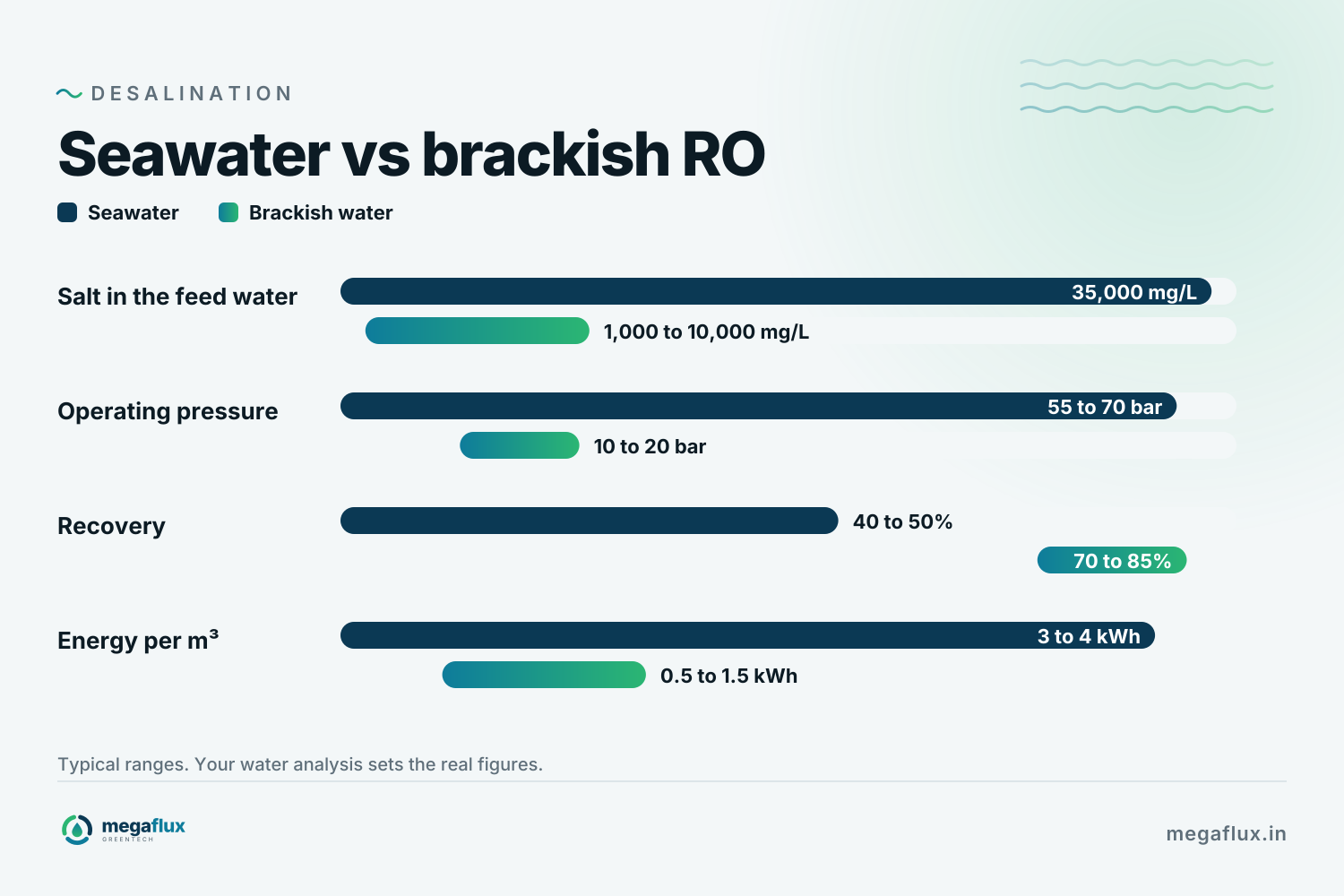
Brackish water is saltier than fresh water but far less salty than the sea. Many borewells, especially in coastal and arid regions, are brackish, typically with 1,000 to 10,000 mg/L of dissolved salts.
Seawater carries around 35,000 mg/L, and more in warm, enclosed seas. That difference of three to thirty times shapes the whole plant.
What changes in the plant
Pressure. To overcome seawater's much higher osmotic pressure, a seawater RO plant runs at around 55 to 70 bar, against 10 to 20 bar for brackish water. That takes bigger high-pressure pumps, and pipes, valves and pressure vessels rated for it.
Membranes. Seawater RO uses membranes designed for high pressure and very high salt rejection. Brackish water membranes would not survive the pressure, or reject enough salt.
Materials. Hot, salty, high-pressure water is very corrosive. The high-pressure parts of a seawater plant are usually built from duplex or super duplex stainless steel, where a brackish plant can often use ordinary stainless steel and plastics.
Recovery. A brackish plant typically turns 70 to 85% of its feed into treated water. A seawater plant usually recovers 40 to 50%: push it further and the brine becomes so concentrated that pressures and scaling risk climb steeply. So a seawater plant needs roughly twice the feed water, and produces far more brine, for the same output.
Energy. All that pressure costs power. A seawater plant typically uses 3 to 4 kWh per m³ of fresh water, even with energy recovery, against 0.5 to 1.5 kWh for brackish water.
Energy recovery: the part that makes seawater RO affordable
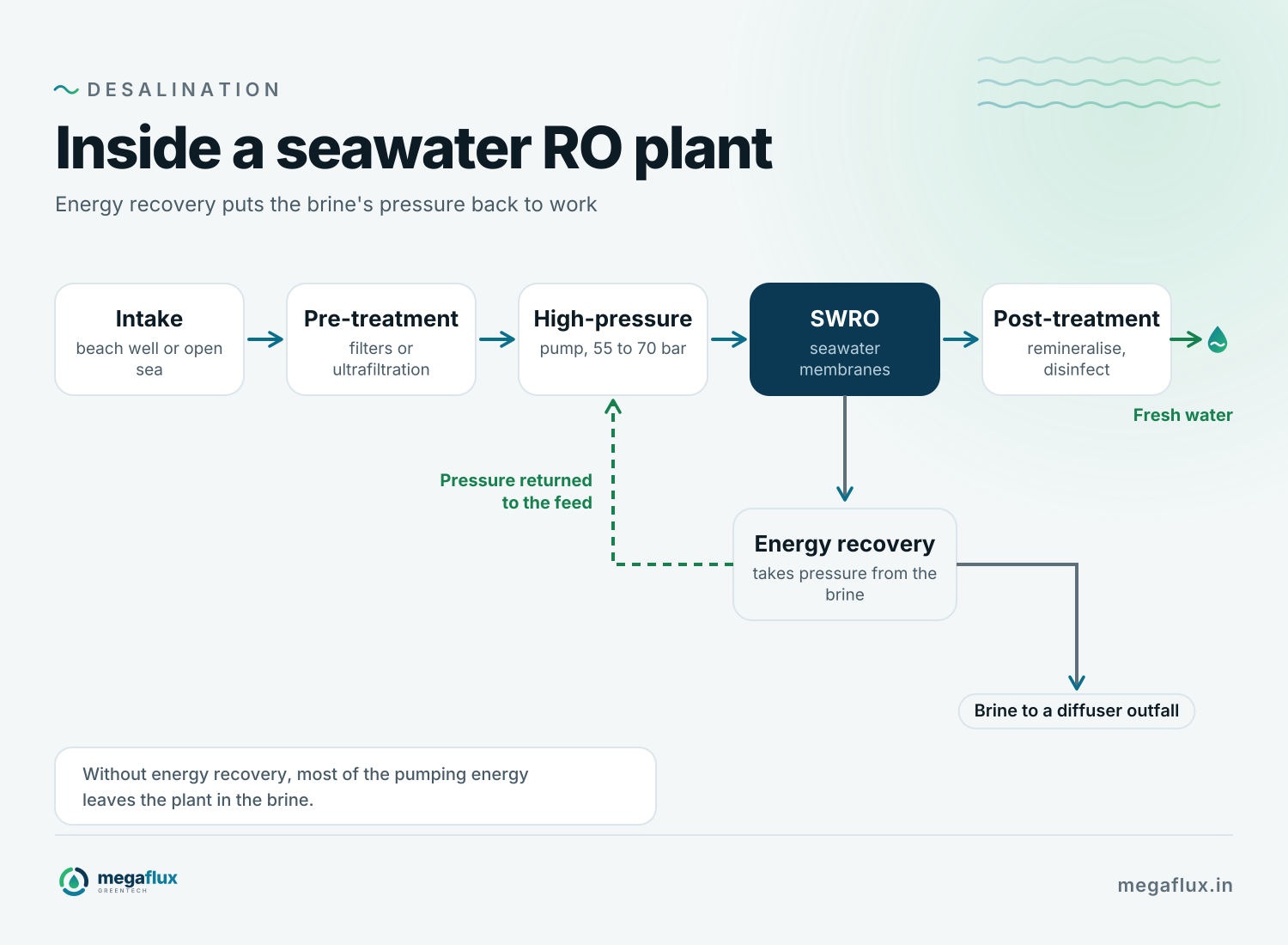
The brine leaving a seawater membrane is still at very high pressure. Without energy recovery, that energy would simply be thrown away down the drain. An energy recovery device transfers the brine's pressure back to the incoming seawater, so the high-pressure pump does much less work. Modern devices recover most of that energy, and they are the main reason seawater desalination costs what it does today, not several times more.
Pre-treatment and post-treatment
Pre-treatment matters even more for seawater. The sea brings silt, algae and marine growth, and conditions change with tides, storms and seasons. Seawater plants often use ultrafiltration ahead of the membranes, and some need extra steps for algae blooms.
Post-treatment is needed because seawater RO water is so pure it is aggressive. It is usually remineralised to make it stable and fit for drinking, and disinfected. Some uses, such as drinking water and irrigation, may also need extra treatment to lower boron, which seawater membranes pass more readily than other salts.
Brine
A seawater plant produces a lot of concentrated brine, and it has to go somewhere. Usually it is returned to the sea through a diffuser outfall designed to mix it quickly, within the limits set for the site. Planning the intake and the outfall together is part of designing the plant, not an afterthought.
Which do you have?
If your source is the sea, the answer is clear. But coastal borewells are often brackish, and their salinity can rise as the water table falls or in the dry season. Before choosing a plant, test your water more than once, ideally across seasons, so the plant is designed for the worst water it will see, not the best.
Send us your water analysis and how much fresh water you need each day, and we'll recommend whether a seawater desalination plant or a brackish water RO plant fits your site.